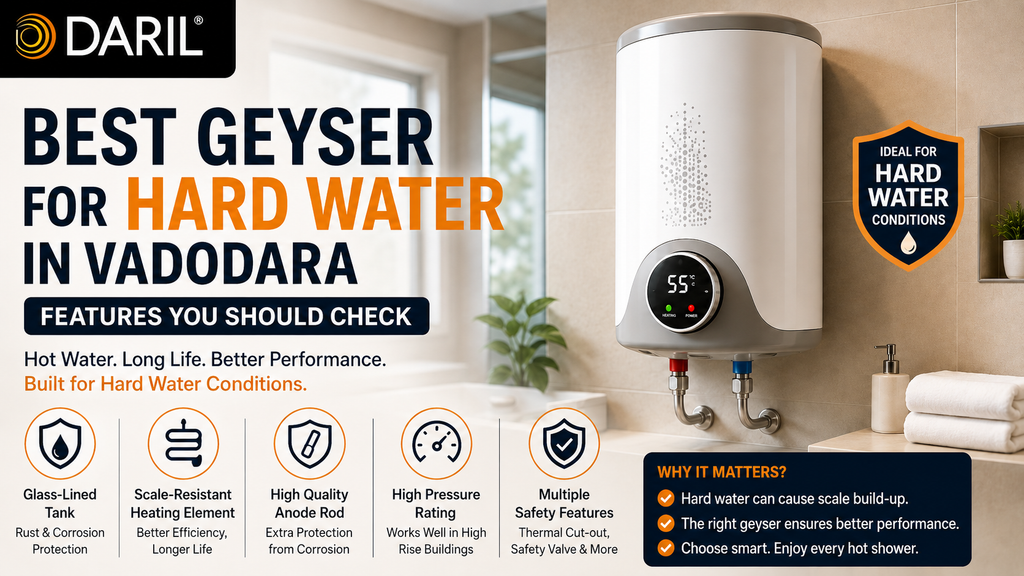
If your home receives hard water, the best geyser is not simply the model with the highest wattage or the longest feature list. For hard-water conditions, prioritise a corrosion-resistant inner tank, a scale-resistant heating element, an effective anode rod, a suitable pressure rating, strong insulation, recognised safety compliance, and accessible after-sales maintenance.
Hard water contains dissolved calcium and magnesium. When water is heated, mineral deposits can build up on heating elements and inside hot-water systems. This scale can reduce heat transfer and place extra stress on the appliance over time. The UK’s Drinking Water Inspectorate classifies water at 200 to 300 mg/L as CaCO3 as hard and above 300 mg/L as very hard. These ranges are useful for understanding hardness, though they are not Indian geyser rating categories.
If you are comparing products through a geyser distributor in Vadodara, ask about water quality before discussing design or smart features. Vadodara Municipal Corporation states that the city receives water from several sources, including radial wells and tube wells in the Mahi River, Ajwa Lake, and different parts of the city. Because the source can differ, it is sensible to check water quality at your own tap rather than assume one hardness level applies across Vadodara. This is an inference from VMC’s mixed-source supply information.
For most homes with hard water, a well-built storage geyser with a protected tank, a suitable heating element, and a replaceable protective anode is usually worth considering.
What Does Hard Water Do to a Geyser?
Hard water itself does not mean your geyser will fail quickly. The problem is the mineral scale that can form as water is repeatedly heated.
Calcium and magnesium compounds can leave hard deposits on surfaces exposed to hot water. Government water guidance notes that these deposits can accumulate on heating elements, reducing appliance efficiency over time.
Water-heater manufacturers also design specific parts around this issue. A. O. Smith India, for example, explains that hard-water minerals can form chalky scale on the tank and heating element, interfering with heating performance as deposits accumulate.
Typical signs that a geyser may need inspection include:
- Heating taking longer than before
- Reduced hot-water output
- Unusual sounds during heating
- Visible sediment during draining
- Frequent heating-element issues
- Rust-coloured water
- Leakage around the tank or fittings
These signs can have several causes. Do not assume hard water is responsible without inspection.
Which Geyser Features Matter Most for Hard Water?
| Feature | Why it matters in hard water | Buying priority |
| Protected inner tank | Helps isolate metal from water and corrosion | Very high |
| Scale-resistant heating element | Reduces direct scale impact on the element | Very high |
| Anode rod | Helps protect the tank from corrosion | Very high |
| BEE star label | Helps compare storage-water-heater efficiency | High |
| Suitable pressure rating | Important for building water pressure | High |
| Thermal cut-out | Adds protection against abnormal heating | Essential |
| Safety valve | Helps manage excess pressure | Essential |
| Good insulation | Reduces stored heat loss | High |
| Service access | Makes maintenance easier | High |
Let’s examine each feature in detail.
1. What Tank Material or Coating Is Best for Hard Water?
The inner tank is one of the most important parts of a storage geyser.
BIS certification documentation for stationary storage electric water heaters recognises tank constructions, including stainless steel, copper, vitreously enamelled tanks, and other manufacturer-declared materials.
For hard-water use, look for a system designed to reduce direct exposure of the metal tank to water. Depending on the manufacturer, this may be described as:
- Glass-lined tank
- Vitreous enamel lining
- Enamel coating
- Proprietary glass coating
- Other corrosion-resistant tank technology
Do not choose based solely on the coating’s marketing name. Ask what the actual inner tank is made of, what protective system it uses, and how long the tank’s warranty lasts.
Some manufacturers specifically design glass-lined tanks for challenging water conditions. A. O. Smith, for example, markets glass-lined storage tanks for improved corrosion resistance in hard-water conditions.
You can compare available electric geyser options before deciding which tank construction suits your home.
2. Which Heating Element Is Better for Hard Water?
The heating element transfers electrical energy into the water, so scale forming directly on it can affect performance.
A conventional exposed element may gradually collect mineral deposits when used with hard water. Therefore, check whether the manufacturer specifically states that the element is suitable for high-mineral water.
Features you may see include:
- Incoloy heating elements
- Glass-coated elements
- Enamel-coated elements
- Other scale-resistant element coatings
Do not assume that the word “Incoloy” alone guarantees trouble-free hard-water performance. The full construction and coating matter.
For example, current A. O. Smith India specifications describe glass-coated Incoloy heating elements on selected storage heaters and state that the coating is intended to resist scale formation.
The practical buying question should be:
“What protects this heating element from scale, and what warranty applies to it?”
That question is more useful than asking only how many watts the geyser consumes.
3. Why Is an Anode Rod Important?
A sacrificial anode is designed to help protect the inner metal tank from corrosion.
In many storage water heaters, the anode gradually deteriorates while helping protect the tank. That means it should not be treated as a permanent, maintenance-free component.
Current hard-water-oriented water heaters may advertise longer life or specialised anode systems. Manufacturer specifications show that anode protection is often paired with glass-lined tanks and coated heating elements in products intended for tougher water conditions.
Before buying, ask:
- Does the model have an anode rod?
- What material is it?
- Can it be inspected and replaced?
- Does water quality affect the inspection interval?
- Is anode replacement covered during service?
There is no universal replacement period for every geyser. Water chemistry, usage and product design all affect anode life. Follow the manufacturer’s maintenance instructions.
4. Should You Buy a 5-Star Geyser?
If you are buying a stationary electric water heater for storage, the BEE label is important.
The Bureau of Energy Efficiency currently lists stationary storage electric water heaters among appliances in the mandatory Standards and Labelling programme. BEE rates appliance efficiency on a 1- to 5-star scale, with 5 stars representing the highest efficiency level within the applicable rating framework.
A higher star rating can help reduce standing heat loss, but it does not mean the product is automatically better for hard water.
Think of these as separate questions:
Hard-water durability: tank, element, anode and maintenance.
Energy efficiency: BEE star rating, insulation and standing loss.
Ideally, you want both.
BIS’s IS 2082 product manual includes a 24-hour standing loss test among the tests for storage electric water heaters.
5. How Much Geyser Capacity Do You Need?
Capacity depends on how you use hot water, not simply on how many people live in the house.
A general planning approach is:
| Use case | Capacity worth comparing |
| Kitchen or limited hand washing | Small or instant heater |
| One-person bathroom use | 10 to 15 L storage |
| Typical shower use | 15 to 25 L storage |
| Higher simultaneous demand | 25 L or more |
These are planning ranges, not fixed engineering rules.
Your required capacity varies with shower flow, inlet water temperature, thermostat setting, bathing habits, and recovery time.
For hard water, avoid buying an oversized tank without need. More stored water means more tank surface and more water being repeatedly heated. Choose the capacity that suits actual demand.
6. What Pressure Rating Should You Check?
Water pressure matters, especially in multi-storey apartments or homes using pressure pumps.
A water heater must be suitable for the installation’s pressure conditions. Several current residential storage models, for example, are rated at 8 bar, but that does not mean every Vadodara home requires an 8-bar unit.
Ask your installer to confirm actual site requirements.
Avoid assuming:
“High-rise home equals buy any 8-bar geyser.”
The correct pressure rating should be based on the plumbing system, building height, pump arrangement and manufacturer instructions.
7. Which Safety Features Should a Geyser Have?
Hard-water durability should never come before electrical and pressure safety.
BIS currently lists appliances for stationary storage electric water heaters under compulsory certification requirements. The applicable listings include IS 2082:2018 and safety requirements for stationary storage electric water heaters.
The current BIS product manual includes testing related to:
- Earthing
- Pressure
- Protection from live parts
- Power input and current
- Heating
- Leakage current
- Electric strength
- Mechanical strength
- Resistance to heat and fire
- Resistance to rusting
When shopping, look for features such as a thermostat, a thermal cut-out, and a suitable pressure-relief or multi-function safety valve. Selected manufacturer specifications also combine thermal cut-outs with safety valves for over-temperature and pressure protection.
Have electrical connections, earthing and plumbing completed by a competent professional.
If you are renovating the electrical board at the same time, review suitable electrical switches and controls, and have the geyser circuit requirements professionally checked.
How Do You Know If Your Vadodara Home Has Hard Water?
Do not rely only on white marks around taps.
Those deposits may suggest mineral-rich water, but the better option is a water-quality test.
A laboratory hardness result is commonly expressed in mg/L as calcium carbonate (CaCO3). Drinking Water Inspectorate guidance classifies:
| Total hardness | General classification |
| Up to 100 mg/L | Soft |
| 100 to 150 mg/L | Slightly hard |
| 150 to 200 mg/L | Moderately hard |
| 200 to 300 mg/L | Hard |
| Above 300 mg/L | Very hard |
Again, this table is a practical hardness classification, not a substitute for Indian drinking-water standards or a manufacturer’s geyser warranty conditions.
Ask the geyser manufacturer whether its warranty includes any stated limits or exclusions related to water quality, TDS or hardness.
Does a Water Softener Protect a Geyser?
A properly selected softening system can reduce calcium and magnesium hardness, thereby reducing scale formation.
Ion-exchange softeners work by replacing calcium and magnesium ions with sodium ions. Water-quality authorities note that softening can reduce scale in hot-water systems and appliances.
However, a softener is not automatically necessary for every home.
First test the water. Then consider:
- Actual hardness
- Geyser manufacturer’s water requirements
- Household water usage
- Maintenance cost
- Plumbing layout
- Drinking-water implications
Do not install treatment equipment solely because a salesperson calls the water “hard.”
How Often Should a Hard-Water Geyser Be Serviced?
There is no single service interval suitable for every model.
Harder water and heavier use may cause scale to develop faster. Manufacturer guidance confirms that scale buildup can affect tanks and heating elements over time.
A practical maintenance plan can include:
- Checking the manufacturer’s service schedule
- Inspecting the heating element for scale
- Checking the anode condition where applicable
- Inspecting safety-valve operation
- Looking for corrosion or leakage
- Removing sediment when recommended
- Checking wiring and earthing
Do not open, descale or repair an electric geyser yourself unless you are qualified and the manufacturer permits the procedure.
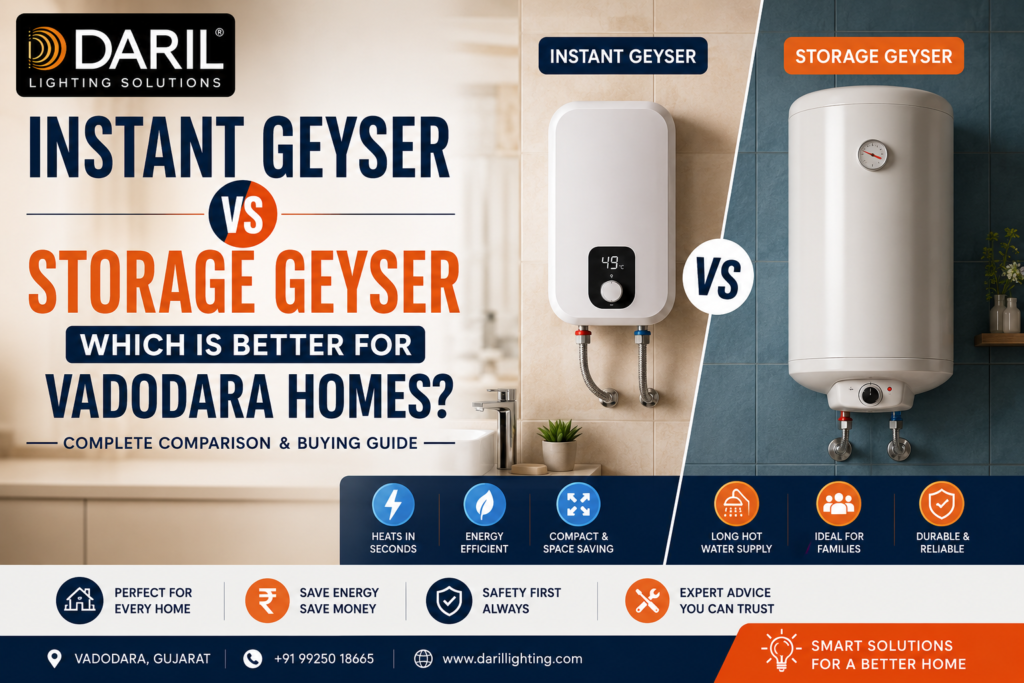
Storage vs Instant Geyser: Which Is Better for Hard Water?
Neither type is automatically immune to hard water.
A storage geyser provides a larger hot-water reserve but has a tank that remains exposed to water. An instant heater stores little or no water, but its heating path can still experience mineral deposits.
For regular family bathroom use, a storage geyser is often easier to match to shower demand. For a kitchen or low-volume requirement, an instant model may be more practical.
Choose by use case first, then check whether the specific model’s water-contact components suit your water quality.
Quick Hard-Water Geyser Buying Checklist
Before paying, ask the dealer these questions:
- What is the inner tank material?
- Does it have glass, enamel or another protective lining?
- What type of heating element does it use?
- Is the heating element designed for hard-water conditions?
- Does it have a replaceable anode rod?
- What is the BEE star rating?
- What is its rated water pressure?
- What safety valve and thermal protection are included?
- What warranty applies to the tank and heating element?
- Are there water-quality exclusions in the warranty?
- Is local service available?
- What maintenance schedule does the manufacturer recommend?
This checklist will tell you more than a long list of smart features.
Frequently Asked Questions
1. Which type of geyser is best for hard water?
Look for a storage geyser with a protected inner tank, a scale-resistant heating element, an effective anode system, a suitable pressure rating, and recognised safety compliance. No tank or coating makes a geyser completely immune to scale.
2. Is a glass-lined geyser good for hard water?
A glass or vitreous enamel lining can help protect the tank’s metal from direct water contact. Several manufacturers use glass-lined tanks in models designed for challenging water conditions.
3. Is Incoloy better than copper for hard water?
Material alone does not decide performance. Check the complete heating-element construction, including protective coatings and the manufacturer’s stated suitability for hard water. Some current models pair Incoloy elements with glass coatings specifically to improve scale resistance.
4. Does hard water increase geyser electricity consumption?
Heavy scale on a heating element can reduce heat transfer efficiency, making heating less effective over time. Both water-quality authorities and water-heater manufacturers identify scale as a factor that can reduce appliance efficiency.
5. Does a 5-star geyser solve hard-water problems?
No. The BEE star rating relates to energy performance, not hard-water resistance. Evaluate the BEE label separately from tank protection, element construction and anode design.
6. Should I test my water before buying a geyser?
Yes, especially if you use borewell or groundwater or regularly notice heavy scale. Vadodara uses multiple water sources, so testing your home’s actual supply is more useful than assuming one hardness figure applies everywhere.
Conclusion
The best geyser for hard water in Vadodara is the one that matches your actual water quality, hot-water demand, plumbing pressure and maintenance needs. Start with a hardness test where possible. Then compare the tank lining, heating element protection, anode design, BEE efficiency, pressure rating, safety certification, warranty, and local service. Avoid choosing only by price, wattage or claims such as “hard-water proof.” If you want to compare practical options for your bathroom or kitchen, you can contact the team at Daril Lighting Solutions to review suitable water heaters.