Choosing the right ceiling fan size starts with one simple rule: match the fan sweep to the room area. For many Indian bedrooms, a 1200 mm fan is a practical starting point. Smaller rooms may work better with a 600 mm, 900 mm, or 1050 mm fan. Larger bedrooms and living rooms may require a 1400 mm fan or multiple fans.
For a 12 ft by 12 ft bedroom, which is 144 square feet, a 1200 mm ceiling fan is usually sensible. A compact study or small kitchen may need only a 900 mm fan.
If you are comparing options from the best ceiling fan dealer in Vadodara, do not choose by blade length alone. Check air delivery, BEE star rating, ceiling height, room shape, mounting position, and clearance from walls and fixtures.
This matters in Vadodara because warm weather can make fans part of daily comfort for much of the year. IMD climate normals for Baroda show average daily maximum temperatures of 39.1°C in April and 39.9°C in May. A ceiling fan does not reduce room temperature like an air conditioner. Moving air helps people feel more comfortable.
The quick answer is simple: measure the room first, select the right sweep range, then compare airflow and energy efficiency within that size.
Ceiling Fan Size Chart for Indian Homes
Use this table as a practical starting point, not as a fixed rule. Ceiling height, layout, furniture, air delivery, and fan design can change the final choice.
| Room Area | Common Room Type | Practical Fan Sweep |
| Up to 50 sq ft | Small balcony, utility area | 600 mm |
| 50 to 75 sq ft | Small kitchen, compact study | 900 mm |
| 75 to 100 sq ft | Study, small bedroom, office room | 900 to 1050 mm |
| 100 to 150 sq ft | Standard bedroom, guest room, kids’ room | 1200 mm |
| 150 to 225 sq ft | Master bedroom, dining room, living room | 1400 mm |
| Above 225 sq ft | Large hall, open living and dining area | Two fans or a layout-specific solution |
Recent Indian fan sizing guidance places 1200 mm fans in the 100 to 150 square foot range and 1400 mm fans in the 150 to 225 square foot range. Treat these ranges as a starting point. A long room, high ceiling, unusual furniture layout, or limited blade clearance may justify a different setup even when the floor area is the same.
A simple rule before you shop
Do not start with color, finish, or smart features. Start with room size. Then check where the fan will sit. Look at the bed, sofa, table, lights, and wall distance to the wall.
Next, compare airflow for fans of the same size. Last, check power use and the BEE label. This order keeps the choice simple. It also helps you avoid paying for features while missing the main goal, which is steady air where people spend time.
What Does Ceiling Fan Size Mean?
Ceiling fan size usually refers to the sweep. Sweep is the diameter of the circle formed by the blade tips as the fan turns.
A 1200 mm fan has a sweep of about 48 inches. A 900 mm fan is about 36 inches. A 1400 mm fan is about 56 inches.
Sweep affects how much area the fan can cover. But a larger sweep does not automatically mean better cooling. Motor design, blade shape, speed, air delivery, and mounting height also affect performance.
How do you measure a ceiling fan?
For an existing fan, measure the distance from blade tip to blade tip through the center. If the fan has an odd number of blades, measure from the center of the motor to one blade tip, then double that distance.
For a new fan, use the manufacturer’s stated sweep size rather than estimating from photos.
How Do You Calculate the Right Fan Size?
Start with the floor area.
Room area = Length × Width
A room that is 10 ft long and 12 ft wide has an area of 120 square feet.
120 sq ft = 10 × 12
That room usually falls into the 1200 mm fan range.
A 12 ft by 12 ft room is 144 square feet. So, 1200 mm is a practical default.
A 15-ft-by-15-ft living room is 225 square feet. A 1400 mm fan may work. But room shape matters. If the space extends into a dining area or has an L-shaped layout, two fans can provide more even airflow.
What Fan Size Is Best for a Bedroom?
Most standard Indian bedrooms work well with a 1200 mm ceiling fan.
For bedrooms under about 100 square feet, a 900 mm or 1050-mm model may be enough. For larger master bedrooms above 150 square feet, consider a 1400 mm fan.
In a master bedroom, measure the full usable room, not just the bed area. Wardrobes, a dresser, a reading chair, or dressing zone can make the real airflow area much larger.
For a kids’ room, also check safe mounting, secure installation, quiet operation, and the position of bunk beds, tall storage, or hanging decor. Keep raised objects well away from the blade path.
What Fan Size Is Best for a Living Room?
Living rooms require more planning because they are often wider, longer, or open to other areas.
For a living room between 150 and 225 square feet, a 1400 mm fan is a useful starting point. In a large hall, two fans can often distribute air more evenly than a single oversized fan in the center.
If the living room connects directly to a dining area, consider both spaces as one airflow zone.
Lighting placement matters too. Decorative fixtures should not block the blade path or push the fan too close to a wall. If you are planning the ceiling from scratch, review decorative lighting options for home interiors before fixing fan and light points.
What Fan Size Works Best for a Kitchen?
Kitchens need balanced airflow. Too much direct air can disturb a gas flame, spread cooking fumes, or blow lightweight items around.
For a compact kitchen between 50 and 75 square feet, a 900 mm fan may be enough. A larger kitchen may need a 1050 mm or 1200 mm model depending on the layout.
A ceiling fan should support comfort, not replace a chimney or exhaust system. Place it so airflow does not interfere with the cooktop or exhaust path.
Why Does Ceiling Height Matter?
A fan can have the right sweep and still perform poorly if it sits too close to the ceiling or too high above the people in the room.
ENERGY STAR recommends installing ceiling fans at least 7 feet above the floor. It suggests 8 to 9 feet when the ceiling height allows. Its general guidance also recommends keeping blades at least 18 inches from walls.
These are useful airflow and safety references. Indian homeowners should also follow the fan manufacturer’s installation instructions and applicable local electrical requirements.
BIS lists IS 374:2019 for electric ceiling-type fans under India’s compulsory certification framework.
For a low ceiling, use a suitable low-profile mounting method only if the fan is designed for it. Do not alter mounting parts just to make the fan fit.
For a high ceiling, a longer downrod may bring the fan to a better working height. Buying a larger fan does not correct a poor mounting position.
Is a Bigger Ceiling Fan Always Better?
No. Bigger is not always better.
A fan that is too large can dominate a small ceiling, reduce usable clearance, and create uncomfortable airflow. A fan that is too small may still leave corners.
Use five checks before buying:
- Measure the full room area.
- Match the area to a practical sweep range.
- Check blade clearance from walls and fixtures.
- Compare air delivery between models of the same size.
- Check BEE rating and rated power.
The goal is balanced airflow throughout the occupied space.
Why Air Delivery Matters as Much as Sweep
Two 1200 mm fans can perform differently.
Air delivery tells you how much air a fan moves. In India, manufacturers commonly express it in cubic meters per minute, or CMM. When comparing fans with the same sweep, check the rated air delivery and the power input.
This is why RPM alone should not decide your purchase. A high RPM figure does not always mean better room coverage. Blade design, motor performance, and air delivery also matter.
When comparing models in the ceiling fan range, first choose the right sweep. Then compare performance features within that size.
How Important Is the BEE Star Rating?
The BEE star label helps Indian consumers compare energy efficiency. BEE uses a 1-to-5-star scale. Higher star ratings show better energy efficiency within the relevant product category.
Ceiling fans are currently listed by BEE among appliances subject to mandatory labeling.
BEE reports that its full Standards and Labeling program delivered 89.80 billion units of energy savings in 2025 across covered appliances and equipment. This figure covers the entire program, not just ceiling fans.
For a fan that may run for many hours, energy use matters. Compare star rating, rated power, and air delivery rather than wattage alone.
Should You Choose BLDC or a Regular Fan?
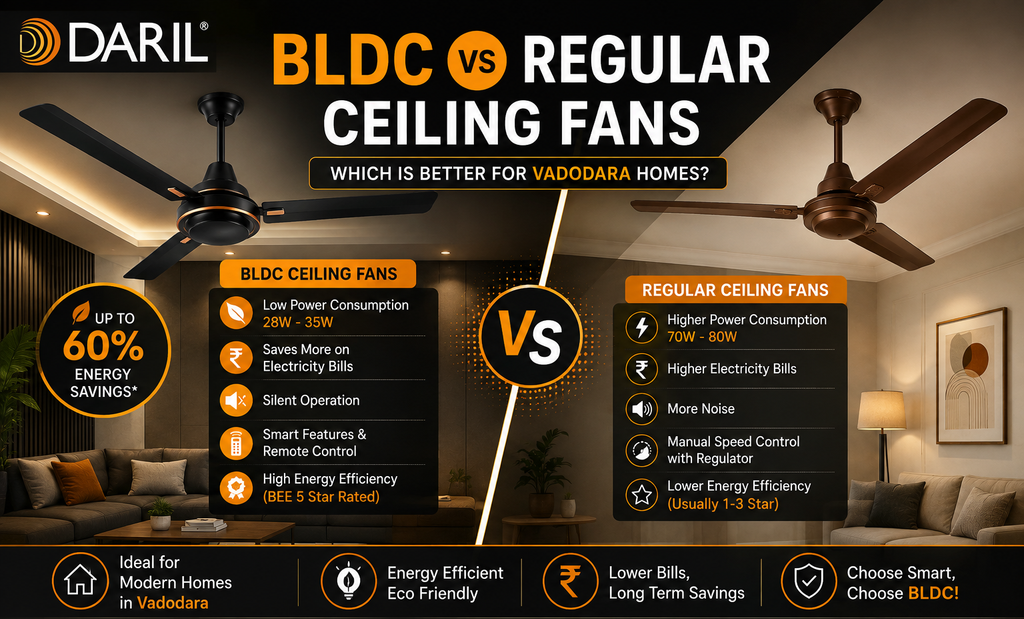
BLDC means brushless direct current. These fans use electronic motor control. Many models consume less electricity than older conventional designs.
Still, motor type should not replace correct sizing.
Compare sweep, air delivery, BEE star rating, rated power, noise, control compatibility, warranty, and service support.
An efficient fan that is too small for the room can still give poor coverage. Get the size right first.
When Do You Need Two Ceiling Fans?
Two fans may make more sense in a large, long, open-plan room or one divided into separate seating zones.
Consider two fans when:
- The space is roughly 225 square feet.
- The room is long and rectangular.
- Living and dining areas share one open space.
- One central fan cannot reach key seating areas.
- A central chandelier limits fan placement.
Plan fan positions before false ceiling work or decorative fixtures are finalized.
Quick Buying Checklist for Vadodara Homes
Before buying, confirm:
- Room length and width.
- Total area in square feet.
- Recommended fan sweep.
- Ceiling height.
- Wall and fixture clearance.
- Air delivery.
- BEE star rating.
- Rated power.
- Motor type.
- Noise level.
- Control method.
- Warranty and service support.
For a new interior project, coordinate fan and LED lighting choices before installation to avoid crowding the ceiling.
Frequently Asked Questions
What size ceiling fan is best for a 12-by-12 room?
A 12-ft-by-12-ft room is 144 square feet. A 1200 mm, or about 48-inch, ceiling fan is usually a practical choice for an Indian bedroom of this size. Also check air delivery, ceiling height, and blade clearance.
Is a 1200 mm ceiling fan enough for a bedroom?
Yes. A 1200 mm fan suits many bedrooms between about 100 and 150 square feet. A smaller bedroom may work with 900 or 1050 mm. A larger master bedroom may need 1400 mm.
Is a 52-inch fan too big for a 12-by-12 room?
Not always. But it is larger than the common 1200 mm choice. Check wall clearance, furniture, ceiling height, airflow preference, and the manufacturer’s guidance before choosing a 52-inch fan. Current fan-sizing resources also commonly treat 1200 mm as a practical starting point for a 12-by-12 room.
How high should a ceiling fan be from the floor?
General ENERGY STAR guidance says ceiling fans should be at least 7 feet above the floor, with 8 to 9 feet preferred when possible. Follow the product manual and local electrical safety requirements.
How do I know if I need two ceiling fans?
Two fans can make sense when a room is large, long, open plan, or divided into separate seating areas. If one fan cannot move air evenly across the occupied space, two properly placed fans may give better coverage.
Does a higher BEE star rating mean a stronger fan?
No. The BEE star rating focuses on energy efficiency. To judge airflow, also compare sweep, air delivery, rated power, and design. A good choice balances coverage, comfort, and energy use.
Conclusion
The best ceiling fan size is the one that fits your room, not the largest model available. For many Vadodara bedrooms, 1200 mm is a practical starting point. Smaller spaces may need 600 mm to 1050 mm. Larger living rooms and master bedrooms may need 1400 mm or multiple fans.
Measure the room, check ceiling height, review the layout, and compare air delivery and BEE efficiency within the correct size. If you are planning a full interior, consider fans, lights, and decorative fixtures together before installation.
For homeowners who want to compare sizes, finishes, airflow options, and energy-efficient models in person, Daril Lighting Solutions can help you evaluate ceiling fans based on your actual room dimensions and layout, rather than choosing based on appearance alone.