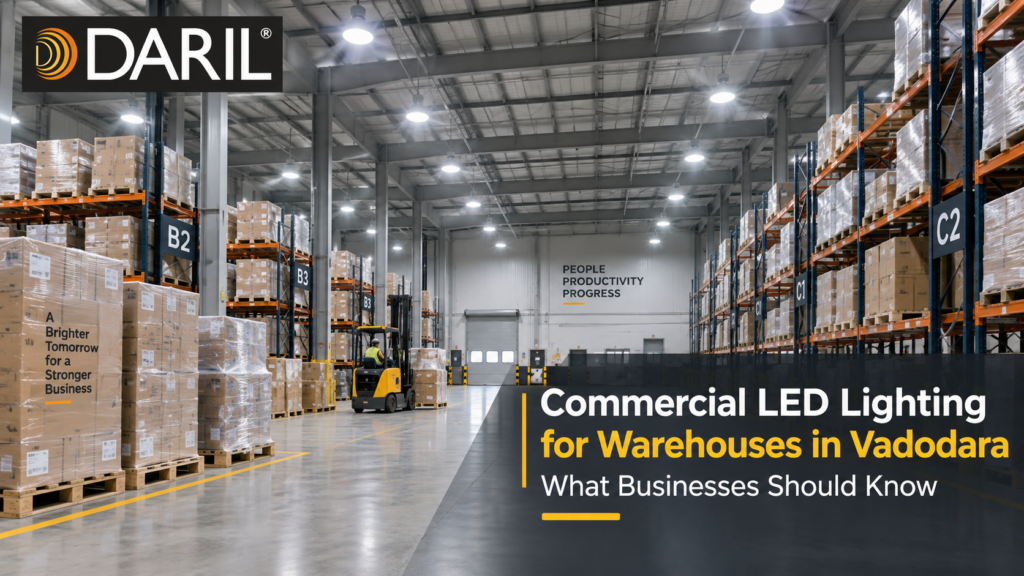
Choosing warehouse lighting is not as simple as replacing old fixtures with brighter LEDs. A good lighting system should help workers see clearly, move safely, read labels, operate equipment, and complete tasks without excessive glare or dark spots.
For businesses considering commercial LED lighting in Vadodara, the first step is to understand how the warehouse is actually used. Measure the ceiling height, map the racks and aisles, identify work zones, note operating hours, and decide how much light each activity needs.
A high-ceiling storage warehouse may need high-bay LED fixtures. A lower-ceiling facility may work better with low-bay or linear lighting. Packing tables, inspection areas, loading bays, and emergency routes may require dedicated lighting rather than relying solely on general overhead fixtures.
Bureau of Indian Standards guidance states that storage and warehouse buildings should have at least 50 lux of illumination. However, businesses should not treat this as the correct target for every task. Packing, sorting, inspection, reading small labels, and other detailed work can need higher task lighting.
The best approach is to plan for lux, lumens, mounting height, beam angle, uniformity, glare, energy efficiency, controls, and safety together. This guide explains how to evaluate each factor before investing in a new warehouse LED system.
What Is Commercial LED Warehouse Lighting?
Commercial warehouse lighting uses LED luminaires designed for large working and storage spaces where lights may operate for many hours each day.
Warehouse fixtures often need to illuminate large floor areas from a greater height than lights used in homes or offices. They may also need to handle dust, heat, moisture, vibration, or outdoor exposure.
Common warehouse LED fixtures include:
- High bay LED lights
- Linear high bay lights
- Low-bay LED fixtures
- LED floodlights
- Aisle lighting
- Task lights
- Emergency lights
- Outdoor loading area lights
The right combination depends on the warehouse layout.
Businesses comparing fixture categories can start by reviewing available LED lighting solutions and then narrow the choice based on technical requirements.
Why Does Warehouse Lighting Need Careful Planning?
A warehouse is different from a shop, office, or home.
It may have tall pallet racks, narrow aisles, forklifts, loading areas, packing stations, stairways, and storage zones with little daylight.
A lighting plan should help people see where the work actually happens.
Poor lighting can create:
- Dark spots between racks
- Strong shadows
- Excessive glare
- Uneven light across aisles
- Difficulty reading labels
- Poor visibility around moving equipment
- Unnecessary electricity use
A brighter fixture alone will not fix all of these problems.
The light must reach the right surface at the right level.
How Much Light Does a Warehouse Need?
Lighting level is commonly measured in lux.
One lux equals one lumen of light falling on one square meter.
BIS standard IS 3594:2024 states that storage and warehouse buildings should have illumination of at least 50 lux. The same standard also includes safety requirements for warehouse electrical fittings and stored goods.
This minimum is useful for general warehouse illumination, but it should not be treated as a universal specification for every task.
A practical planning approach is:
| Warehouse Area | Lighting Requirements to Consider |
| General storage | Basic uniform illumination |
| Walkways and aisles | Clear visibility for safe movement |
| Picking zones | Higher task-focused light |
| Packing tables | Stronger light for labels and details |
| Inspection areas | Higher, controlled illumination |
| Loading docks | Good horizontal and vertical visibility |
| Warehouse office | Office-specific lighting |
| Emergency routes | Dedicated emergency lighting |
BEE’s commercial building guidance also recognizes interior and exterior lighting, controls, occupancy sensors, and daylight use as important parts of energy-efficient building design.
What Is the Difference Between Lumens, Lux, and Watts?
Many buyers begin by asking how many watts a warehouse light should have.
That is not enough.
What are watts?
Watts measure electrical power.
A 150-watt LED uses more electrical power than a 100-watt LED under comparable operating conditions.
But wattage alone does not tell you whether the warehouse floor will receive enough useful light.
What are lumens?
Lumens measure the total amount of visible light produced by a fixture.
Higher lumen output generally means more light leaves the fixture.
What is lux?
Lux measures how much light reaches a surface.
In warehouse design, lux levels are critical because workers need adequate lighting on aisles, racks, labels, packing benches, and equipment.
What is luminous efficacy?
Luminous efficacy tells you how efficiently a fixture turns electrical power into visible light.
The simple formula is:
Luminous efficacy = Lumens ÷ Watts
For example:
A 100-watt fixture producing 15,000 lumens has an efficacy of:
15,000 ÷ 100 = 150 lumens per watt
A more efficient fixture can provide similar output while using less power. However, beam quality, glare, reliability, and distribution still matter.
When Should a Warehouse Use High Bay LED Lights?
High bay LEDs are commonly used in warehouses with high ceilings.
They provide strong light output from a greater mounting height.
Typical applications include:
- Large storage buildings
- Distribution centers
- Industrial sheds
- Manufacturing support areas
- Logistics facilities
High bay luminaires are available in round and linear formats.
When do linear high bays make sense?
Linear high-bay fixtures can work well in long aisles because their light pattern better follows the aisle’s shape.
They may suit:
- Long rack rows
- Distribution aisles
- Rectangular work zones
- Picking areas
When can round high bays work better?
Round fixtures may work well in:
- Open warehouse floors
- Wide storage areas
- Large unobstructed zones
- General industrial spaces
Do not choose the fixture shape only because one design looks modern. Match it to the layout and beam requirements.
How Does Ceiling Height Affect LED Selection?
Mounting height changes how light spreads before reaching the floor.
A fixture installed at 5 meters performs differently from the same fixture installed at 10 meters.
As height increases, businesses may need to consider:
- Higher lumen output
- Different optics
- Narrower beam angles
- Wider fixture spacing calculations
- Better glare control
A narrow beam may concentrate light directly below the fixture.
A very wide beam may spread light too far, reducing useful floor illumination.
The goal is not to create bright circles. The goal is even coverage.
Why is a lighting layout important?
A professional lighting layout can estimate how much light reaches specific areas before installation.
It considers:
- Ceiling height
- Fixture height
- Rack height
- Beam angle
- Lumens
- Fixture spacing
- Surface reflectance
- Target lux
- Work plane height
This is especially useful before ordering dozens or hundreds of fixtures.
Why Is Lighting Uniformity Important?
Uniformity refers to how evenly light is distributed across a space.
Imagine a long warehouse aisle where one section is very bright, and the next is noticeably dark.
Workers and forklift operators must repeatedly adjust their vision as they move through those areas.
Good uniformity reduces large differences between bright and dark zones.
It can also improve visual comfort.
Businesses should not automatically solve dark areas by increasing wattage. Sometimes changing the fixture spacing, beam angle, or mounting position yields better results.
How Can Warehouses Reduce Glare?
Glare happens when a light source appears excessively bright compared with its surroundings.
It can make workers uncomfortable and reduce visibility even when the measured lux level looks acceptable.
Glare can become a problem when employees:
- Look upward toward high shelves
- Operate forklifts
- Read reflective packaging
- Work directly below strong LEDs
- Move between dark and bright zones
Good fixture optics can help control glare.
Lighting designers may also adjust:
- Mounting position
- Fixture spacing
- Beam angle
- Diffusers
- Shielding
- Output level
This is why warehouse lighting should not be judged only from a product specification sheet.
How Much Energy Can LED Warehouse Lighting Save?
LED lighting can reduce energy use, but there is no honest percentage that applies to every warehouse.
The savings depend on:
- Existing lamp type
- Existing wattage
- New LED wattage
- Number of fixtures
- Operating hours
- Lighting controls
- Maintenance condition
BEE states that lighting can account for a meaningful share of commercial building energy use and includes lighting power, controls, daylight integration, and related efficiency measures in its building guidance.
How can you calculate annual lighting consumption?
Use this formula:
Annual energy use = Lighting load in kW × Annual operating hours
Example:
A warehouse currently has a total lighting load of 20 kW.
The lights operate for 4,000 hours each year.
20 × 4,000 = 80,000 kWh per year
Suppose a redesigned LED system provides the required illumination using 12 kW.
12 × 4,000 = 48,000 kWh per year
Estimated reduction:
80,000 minus 48,000 = 32,000 kWh per year
This example does not guarantee that every warehouse will save this amount.
The real calculation should use your existing system, electricity tariff, actual operating hours, and final lighting design.
Should Warehouses Use Motion Sensors and Controls?
Lighting controls can reduce unnecessary operating hours.
This is useful in warehouses where some areas remain unoccupied for long periods.
For example, an active packing station may need continuous light during a shift. A low-traffic storage aisle may only need full illumination when a worker enters it.
Possible controls include:
- Motion sensors
- Occupancy sensors
- Timers
- Daylight sensors
- Zone switching
- Dimming
- Central control systems
BEE’s energy-efficient commercial building framework includes automatic lighting shutoff, occupancy sensors, and other lighting control measures.
Controls should be designed carefully.
Lights should not switch off in a way that creates unsafe conditions around forklifts, stairways, equipment, or emergency routes.
What Color Temperature Is Suitable for Warehouses?
Color temperature is measured in Kelvin.
Many commercial and industrial warehouses use neutral or cool white lighting because it gives work areas a clean, clear appearance.
However, the highest Kelvin rating is not automatically best.
Businesses should also consider CRI, or color rendering index.
CRI describes how accurately colors appear under a light source.
Good color recognition can matter when workers need to distinguish:
- Packaging colors
- Electrical wires
- Labels
- Safety markings
- Product variations
- Inspection defects
Color temperature and CRI should match the type of work taking place.
What IP Rating Should Warehouse Lights Have?
IP means ingress protection.
It describes the level of protection an electrical enclosure provides against dust and moisture.
Different warehouse areas may need different levels of protection.
For example:
A clean indoor storage room may have different requirements from a dusty industrial facility.
A loading bay exposed to rain may need greater moisture protection.
Other environments that deserve closer attention include:
- Food storage areas
- Dusty manufacturing warehouses
- Open sheds
- Humid environments
- Outdoor dispatch areas
Avoid selecting an IP rating only because a larger number sounds better.
The fixture should match the actual environment.
What Safety Factors Should Businesses Check?
Warehouse lighting is also an electrical safety issue.
IS 3594:2024 states that light fittings should have a minimum clearance of 0.75 meters from the highest stacking level. It also includes specific provisions for hazardous storage areas and electrical equipment.
Businesses should check:
- Fixture location
- Wiring condition
- Earthing
- Circuit protection
- Mounting security
- Clearance from goods
- Suitability for the environment
- Emergency lighting
- Applicable BIS requirements
If a warehouse stores high-hazard materials, additional fire and electrical safety requirements may apply.
Use qualified electrical professionals for installation and assessment.
Businesses carrying out a broader electrical upgrade can also review electrical switches and related solutions when planning new circuits or controls.
Why Is Emergency Lighting Important?
Emergency lighting serves a different purpose from normal warehouse lighting.
It helps workers move safely if the main lighting system fails.
Emergency lighting planning should consider:
- Exit routes
- Staircases
- Fire exits
- Changes in floor level
- Safety equipment locations
- Important control points
Businesses should not assume that high-bay lights connected to normal power provide adequate emergency illumination.
Emergency lighting should form part of the warehouse’s wider safety and fire plan.
How Should Businesses Compare Warehouse LED Suppliers?
Price per fixture should not be the only comparison.
Ask potential suppliers for technical information.
Useful questions include:
- How many lumens does the fixture produce?
- What is the wattage?
- What is the lumens-per-watt figure?
- Which beam angle is used?
- What is the color temperature?
- What is the CRI?
- What is the IP rating?
- What driver is used?
- What surge protection is provided?
- What is the warranty?
- Are photometric files available?
- How was the fixture quantity calculated?
A supplier should be able to explain why the recommended product is a good fit for your warehouse.
A simple product list without a lighting plan may not tell you whether the final installation will provide adequate illumination.
What Should a Warehouse Lighting Audit Include?
Before replacing existing lights, record the current condition.
A basic audit should document:
| Item | What to Record |
| Warehouse size | Length, width, total area |
| Ceiling | Height and structure |
| Racks | Height and spacing |
| Existing lights | Type, wattage, quantity |
| Operating hours | Daily and yearly estimate |
| Lighting level | Current lux measurements |
| Work zones | Storage, packing, loading, inspection |
| Controls | Switches, sensors, timers |
| Environment | Dust, moisture, heat |
| Issues | Dark spots, glare, failures |
This provides a baseline.
After installation, the business can compare actual performance with that of the old system.
What Are Common Warehouse LED Lighting Mistakes?
Several mistakes can increase cost or reduce lighting quality.
1. Choosing by wattage only
Wattage measures electrical input, which is not useful for floor illumination.
2. Replacing fixtures one for one
An old fixture layout may not be suitable for modern LEDs.
3. Ignoring rack shadows
Tall racks can block light and leave aisles dark.
4. Using one fixture everywhere
Different areas may need different beam patterns or lux levels.
5. Ignoring glare
More light does not always improve visibility.
6. Forgetting controls
Low-traffic zones can waste electricity if lights operate continuously.
7. Ignoring maintenance
Dust buildup can reduce light output over time.
8. Buying before measuring
A site survey should come before a bulk order.
How Should Businesses Calculate LED Lighting ROI?
Businesses should calculate the total cost rather than only the purchase price.
Include:
- Fixture cost
- Installation
- Wiring or panel changes
- Controls
- Annual electricity use
- Maintenance
- Replacement parts
- Expected operating life
A simple payback estimate is:
Payback period = Total upgrade cost ÷ Annual financial savings
Suppose an LED project costs ₹400,000, and the estimated annual electricity and maintenance savings are ₹125,000.
₹400,000 ÷ ₹125,000 = 3.2 years
This is only an example.
Actual results depend on electricity tariffs, operating hours, fixture performance, maintenance, and the existing lighting system.
Businesses should request the assumptions behind any promised payback calculation.
Frequently Asked Questions
What type of LED light is best for a warehouse?
High-bay LEDs are common for high ceilings, while low-bay or linear fixtures may work better at lower heights or in long aisles. The best fixture depends on the mounting height, beam angle, required lux level, rack layout, and the work being performed.
How many lux does a warehouse need?
IS 3594:2024 states that warehouses should have at least 50 lux. Detailed work such as packing, inspection, sorting, or reading small labels may need higher task-specific illumination.
How many LED lights does a warehouse require?
There is no reliable answer based only on square footage. Fixture quantity depends on lumen output, mounting height, beam angle, warehouse dimensions, racks, target lux, and fixture spacing.
Are high-bay LED lights energy efficient?
High-bay LEDs can offer high efficiency when selected correctly. Compare lumens per watt, actual required output, operating hours, controls, and the current lighting system before estimating savings.
Can motion sensors be used in warehouses?
Yes. Motion and occupancy controls can work well in low-traffic storage zones. They should be planned so that workers and moving equipment are never left in unsafe darkness.
How often should warehouse LED lights be maintained?
Maintenance frequency depends on dust, heat, operating hours, fixture design, and site conditions. Regular inspections and cleaning can help maintain light output and identify failed drivers, damaged fittings, or loose connections.
Conclusion
Choosing commercial warehouse lighting should begin with the work taking place inside the building, not with fixture wattage.
Start by measuring the warehouse, ceiling height, rack layout, and operating hours. Identify areas used for general storage, picking, packing, inspection, loading, and movement.
Then compare lux, lumens, efficacy, beam angle, uniformity, glare, color quality, IP protection, controls, electrical safety, and maintenance.
BIS specifies at least 50 lux for storage and warehouse buildings, but detailed tasks may need more. BEE also encourages efficient lighting design, appropriate lighting power, daylight use, and lighting controls to improve commercial building energy performance.
For a large retrofit or new warehouse, use measured site information and involve a qualified lighting or electrical professional before ordering equipment. This reduces the chance of over-lighting, dark aisles, poor uniformity, or unnecessary electricity use.
Businesses planning commercial LED lighting in Vadodara can review their warehouse dimensions, lighting requirements, fixture specifications, and efficiency options with Daril Lighting Solutions before making a final buying decision.