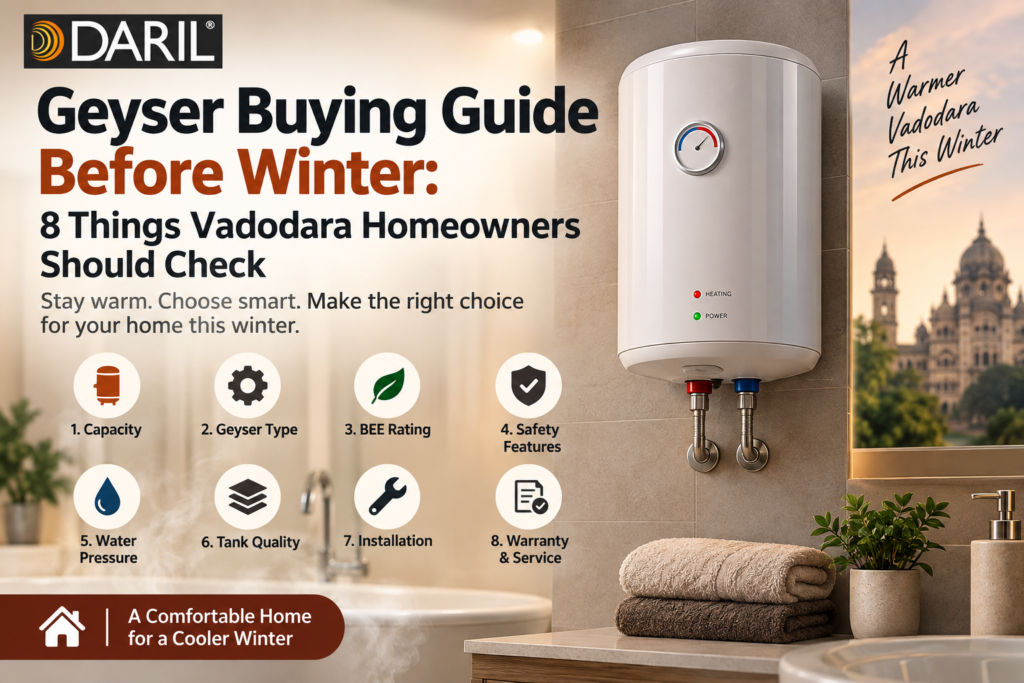
Buying a geyser before winter is not just about choosing a known brand or the largest tank. The right water heater should match your family size, daily hot water use, bathroom setup, water pressure, electrical supply, and energy needs.
For most Vadodara homes, the first things to compare are capacity, BEE star rating, safety features, tank quality, water pressure compatibility, heating performance, installation requirements, and warranty support.
This becomes more important as winter approaches. India Meteorological Department climate data for Baroda show mean minimum temperatures of about 14.3°C in December and 13.2°C in January, based on the 1991 to 2020 climatological period. Hot water can therefore become part of the morning routine for many local households.
If you are visiting a geyser distributor in Vadodara, do not start the conversation with “Which geyser is best?” A better question is, “Which geyser fits my bathroom, family size, usage pattern, and water conditions?”
A 10-liter unit that works well for one household may feel too small for another. Likewise, buying a 25-liter model for light use may mean heating more stored water than you need.
This guide explains the eight checks that matter most, with practical examples for apartments, bungalows, couples, families, and homes with different water pressure conditions.
Quick Geyser Buying Checklist for Vadodara Homes
Here is a quick starting point before we look at each factor in detail.
| What to Check | Why It Matters | Practical Buying Question |
| Capacity | Determines available hot water | How many people will use it? |
| Geyser type | Affects storage and heating pattern | Instant or storage? |
| BEE rating | Helps compare energy efficiency | What is the current star rating? |
| Safety | Important in wet bathroom areas | Is it BIS-compliant and correctly installed? |
| Water pressure | Important in apartments and tall buildings | Can it handle my home’s pressure? |
| Tank and heating element | Affects durability and maintenance | What materials are used? |
| Installation | Affects safety and performance | Is my electrical point suitable? |
| Warranty and service | Matters after purchase | What exactly does the warranty cover? |
Use this table as a shortlist. The final choice should depend on your actual home rather than a generic capacity recommendation.
1. What Geyser Capacity Does Your Family Need?
Capacity is usually the first decision when buying a storage water heater.
Storage geysers come in several capacities. BIS documentation for stationary storage electric water heaters includes capacities such as 6, 10, 15, 25, 35, 50 liters and higher.
For normal home use, 10-, 15-, and 25-liter models are among the sizes buyers commonly compare.
A practical starting point is:
| Household or Use | Capacity to Consider |
| Kitchen or very light use | Small capacity or suitable instant model |
| 1 to 2 people | Around 10 to 15 liters |
| 2 to 4 people | Around 15 to 25 liters |
| Larger family | 25 liters or more, depending on usage |
| High simultaneous demand | Larger storage or separate units |
These are practical shopping ranges, not fixed rules.
Why can two families of four need different geyser sizes?
Because family size alone does not tell the whole story.
Consider two Vadodara families with four members.
Family A takes short bucket baths and uses hot water mainly in the morning. A moderate storage capacity may work well.
Family B prefers showers, uses hot water at different times, and also needs warm water for other tasks. Their daily requirement can be much higher.
Before selecting capacity, ask:
- How many people use the bathroom?
- Do they take showers or bucket baths?
- Will everyone bathe one after another?
- Is the geyser used once or several times daily?
- Does one geyser serve more than one outlet?
This gives you a much better estimate than family size alone.
You can review Daril’s electric geyser options once you’ve identified the capacity range that fits your home.
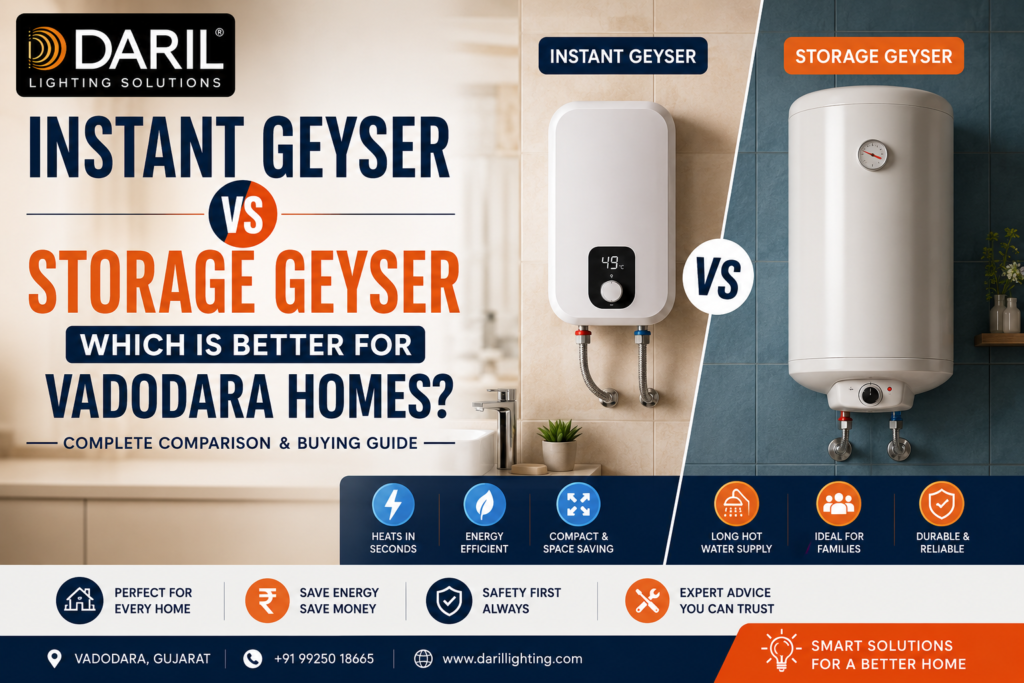
2. Should You Buy an Instant or Storage Geyser?
Both can be useful, but they solve different problems.
What is a storage geyser?
A storage water heater heats water inside an insulated tank and stores it until needed.
It can be useful when:
- Several liters of hot water are needed at once
- Multiple family members use the bathroom
- Shower use is common
- You want stored hot water ready for use
The Bureau of Indian Standards defines IS 2082:2018 for stationary storage-type electric water heaters. The standard covers safety and performance requirements for this category. It was reviewed again in 2026.
What is an instant geyser?
An instant water heater heats water without storing a large volume in a tank.
It may suit:
- Kitchen sinks
- Small households
- Low volume use
- Locations where space is limited
Do not assume “instant” automatically means better or more efficient for every home. Check the electrical load, flow rate, heating performance, and intended use.
For a family bathroom, storage models often deserve closer consideration because hot water demand can be higher.
3. Why Should You Check the BEE Star Rating?
The BEE star label gives Indian buyers a standardized way to compare the energy performance of appliances.
Stationary storage-type electric water heaters are currently included in the Bureau of Energy Efficiency’s mandatory appliance labeling program.
For electric storage water heaters, BEE uses standing loss as an important parameter for star labeling. Lower standing loss is better because it means less heat escapes from stored hot water over time.
What is standing loss?
Standing loss is the energy lost while heated water remains stored in the tank.
Imagine heating water in the morning but using it later. Even with insulation, some heat escapes. A better-insulated storage geyser can reduce this loss.
BEE’s published star rating framework expresses standing loss in kilowatt-hours over a 24-hour period under defined test conditions.
This makes the star label useful when comparing similar storage geysers.
Is a 5-star geyser always the best choice?
Not automatically.
A higher energy rating is valuable, but also compare:
- Correct capacity
- Purchase cost
- Air and water conditions
- Safety certification
- Warranty
- Service availability
- Installation needs
A highly efficient geyser that does not match your usage may still be the wrong choice.
4. What Safety Features Should a Geyser Have?
Safety deserves more attention than appearance or smart controls.
Electric water heaters combine water, electricity, heat, and pressure. That makes proper product selection and installation essential.
BIS lists IS 2082:2018 as a mandatory certification standard for stationary storage-type electric water heaters. It also refers to IS 302 (Part 2/Sec 21):2024, which covers safety requirements for storage water heaters.
The BIS description of these requirements includes areas such as protection from live parts, leakage current, electrical strength, moisture resistance, earthing, pressure protection, and overheating protection.
What should homeowners check?
Look for:
- BIS-compliant product markings, where applicable
- Thermostat control
- Thermal cut-off protection
- Pressure relief or safety valve
- Proper earthing provision
- Suitable electrical wiring
- Secure plumbing connections
- Correct installation
Do not bypass a safety valve or alter the electrical connection to make an unsuitable unit work.
The Central Electricity Authority also maintains regulations on electrical supply and safety, including updates and amendments.
For installation, use a trained electrician or authorized technician who can check the wiring, earthing, socket, protective devices, and electrical load.
5. Can Your Geyser Handle Your Home’s Water Pressure?
This question is especially important for apartments and multi-story buildings.
Water pressure varies depending on:
- Floor level
- Building height
- Overhead tank position
- Pump system
- Plumbing design
- Pressure boosting system
A geyser designed for one pressure condition may not be the right choice for another.
Why does rated pressure matter?
The inner tank and safety system must handle the pressure created within the plumbing system.
BIS certification documentation for storage water heaters includes rated pressure as one of the product characteristics considered under IS 2082.
If you live in a high-rise apartment in Vadodara, tell the seller or installer:
- Which floor do you live on
- Whether your building uses a pressure pump
- Whether water comes from an overhead tank
- Whether you have experienced unusually strong pressure at the taps
Do not select a geyser based solely on its capacity and star rating.
Ask whether the model’s stated pressure rating is suitable for your actual plumbing system.
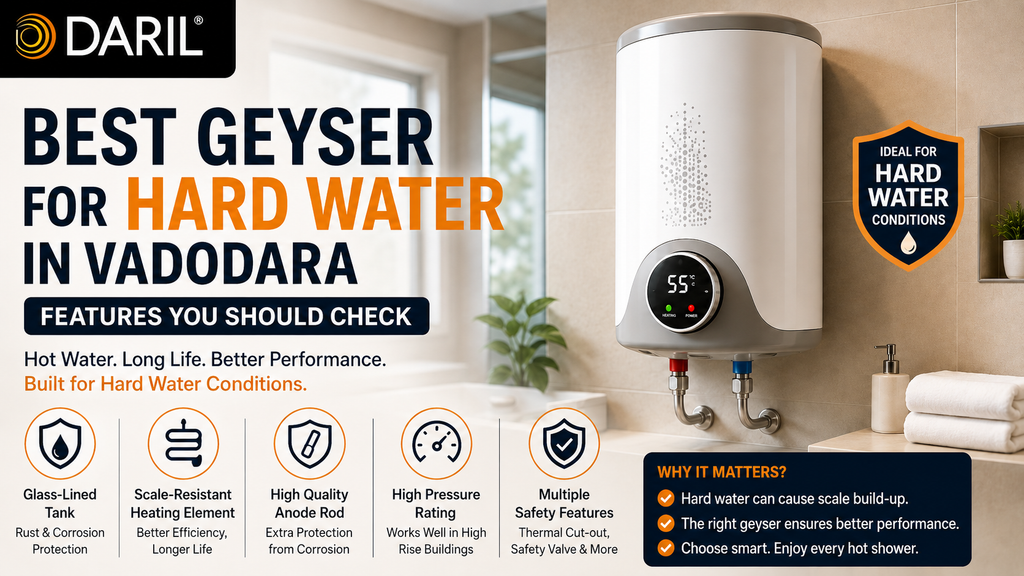
6. Which Tank and Heating Element Materials Should You Check?
Inside a storage geyser are parts you may never see after installation, but they can affect performance and durability.
BIS documentation describes storage water heaters as including components such as an inner tank, heating element, thermostat or thermal cut-off, insulation, and safety devices.
Inner tanks can use materials or protective coatings designed to withstand regular contact with heated water.
Why does water quality matter?
Minerals in water can lead to scale buildup over time.
Scale can form around heating elements and inside the tank. The rate varies with water chemistry, temperature, usage, and maintenance.
Instead of trusting vague claims such as “works with all water,” ask specific questions:
- What is the inner tank material?
- Does the tank use a protective coating?
- What material is the heating element?
- What maintenance does the manufacturer recommend?
- How often should the system be inspected?
- Does the warranty have water quality conditions?
If your building has known hard water issues, mention them before purchasing.
The goal is not to find a “maintenance-free” geyser. It is to choose a unit that suits your water conditions and can be serviced when needed.
7. What Should You Check Before Geyser Installation?
Installation can affect safety, convenience, and product life.
Do not buy a geyser and assume every bathroom is automatically ready for it.
Check the electrical setup first
A qualified technician should review:
- Electrical load
- Wiring condition
- Earthing
- Socket and switch rating
- Circuit protection
- Position of the electrical point
- Manufacturer requirements
BIS safety requirements for storage water heaters specifically cover aspects such as leakage current, moisture resistance, electrical strength, and earthing.
If you are renovating your bathroom or replacing old fittings, it may also be useful to check the condition of your electrical switches and fittings before connecting the new appliance.
Check the plumbing setup
The technician should also assess:
- Inlet and outlet connections
- Available wall space
- Mounting strength
- Pipe routing
- Water pressure
- Safety valve arrangement
- Drainage around the installation area
A heavy storage geyser filled with water places a significant load on its mounting point. The wall and brackets must be suitable.
Do not install it on a weak surface merely because that spot looks convenient.
8. What Warranty and After-Sales Support Should You Compare?
Warranty terms deserve as much attention as specifications.
Different parts may have different warranty periods. For example, the overall product, inner tank, and heating element may not all have identical coverage.
Before paying, ask:
- How long is the product warranty?
- Is the inner tank covered separately?
- Is the heating element covered?
- Does installation affect warranty validity?
- Is authorized service available in Vadodara?
- Are home service visits available?
- Which failures are excluded?
- Is preventive maintenance recommended?
Read the written warranty rather than relying solely on a salesperson’s verbal explanation.
Keep the invoice, model number, warranty documentation, and installation details in one place.
A local showroom can also be useful when you want to understand dimensions, controls, finish, installation requirements, and service terms before purchase. You can contact Daril Lighting Solutions to discuss product specifications for your home.
How Much Electricity Does a Geyser Use?
Electricity use depends on more than tank size.
The main factors include:
- Rated wattage
- Heating duration
- Amount of hot water used
- Incoming water temperature
- Thermostat setting
- Insulation
- Standing heat loss
- Number of heating cycles
For example, a 2 kW heater running its heating element continuously for one hour would theoretically use about 2 kWh of electricity.
However, that does not mean every 2 kW geyser consumes 2 units every hour throughout the day. The heating element switches according to water temperature and thermostat operation.
That is why comparing only wattage can be misleading.
For storage heaters, the BEE star label and standing loss information provide a more useful basis for comparing efficiency between suitable models.
What Common Geyser Buying Mistakes Should You Avoid?
Many buying mistakes happen because shoppers compare visible features first.
Avoid these common errors:
- Buying capacity without calculating actual hot water use
- Assuming a bigger tank is always better
- Ignoring BEE efficiency
- Choosing only by price
- Ignoring building water pressure
- Not checking BIS compliance
- Using unsuitable existing wiring
- Treating installation as an afterthought
- Ignoring tank and heating element warranties
- Assuming every model suits hard water conditions
- Buying before measuring the installation space
A simple 10-minute check of your bathroom, family needs, electrical point, and plumbing system can make your showroom comparison much more useful.
Which Geyser Is Best for a Vadodara Home?
There is no single geyser that is best for every household.
The right model is the one that fits your usage and installation conditions.
For example:
Couple in a compact apartment:
A smaller storage capacity may be enough if both users have moderate hot water needs.
Family of four:
A 15- to 25-liter storage model may be worth considering, depending on shower habits and how closely family members use the bathroom.
High-rise apartment:
Pressure compatibility becomes an important buying factor.
Home with frequent hot water use:
Energy efficiency, insulation, capacity, and recovery time become more important.
Kitchen use:
A smaller capacity or a suitable instant heater may make more sense than a large bathroom storage model.
This is why product selection should start with questions about your home, not with a brand name.
Frequently Asked Questions About Buying a Geyser
What size geyser is suitable for a family of four?
A family of four may consider a 15 to 25-liter storage geyser as a practical starting range. The final capacity depends on shower habits, how quickly family members use hot water in succession, and how much hot water each person needs.
Is a 15-liter geyser enough for a bathroom?
A 15-liter geyser can be enough for many small households and moderate bathroom use. If several people take long showers one after another, a larger capacity may provide more convenience.
Which is better, a 3-star or 5-star geyser?
A 5-star model is generally more energy-efficient under the BEE rating system than a comparable lower-rated model. However, compare models with similar capacity and suitability for use. Safety, water pressure compatibility, warranty, and purchase cost also matter.
How long does a geyser take to heat water?
Heating time varies with tank capacity, heating element power, incoming water temperature, thermostat setting, and design. Check the manufacturer’s stated heating or recovery information for the exact model instead of assuming all 15 or 25-liter units heat at the same speed.
Should I switch off the geyser after use?
For many households, switching the unit off when hot water is not needed for an extended period can avoid unnecessary standby heating. Follow the manufacturer’s operating guidance. Do not repeatedly alter wiring or use unsafe switching arrangements to control the appliance.
What should I check before installing a geyser?
Check the wall strength, available space, electrical wiring, earthing, circuit protection, water pressure, inlet and outlet plumbing, and the manufacturer’s installation instructions. Use a trained installer or qualified electrician rather than making electrical modifications yourself.
Final Geyser Buying Checklist Before Winter
Before making the final purchase, confirm these eight points:
| Check | Final Question |
| 1. Capacity | Does the size match our actual hot water use? |
| 2. Type | Do we need storage or instant heating? |
| 3. BEE rating | How efficient is the model? |
| 4. Safety | Does it meet applicable safety and certification requirements? |
| 5. Pressure | Is it suitable for our building’s water pressure? |
| 6. Tank quality | Are the inner tank and heating element suitable for our use? |
| 7. Installation | Is our electrical and plumbing setup ready? |
| 8. Warranty | What is covered, and is local service available? |
Conclusion
Buying a geyser before winter becomes much easier when you stop searching for one universal “best” model and start with your own requirements.
Measure your available space. Estimate daily hot water use. Choose a suitable capacity. Compare the BEE rating and standing loss. Check BIS certification, pressure compatibility, tank construction, electrical requirements, warranty, and local service.
Most importantly, do not compromise on electrical safety to save on installation costs. Water heaters should be installed according to the manufacturer’s requirements and checked by a trained professional.
If you want to compare geyser capacity, energy efficiency, design, installation requirements, and suitable options for your home before winter, Daril Lighting Solutions can help you review the practical differences so you can make a more informed choice for your home in Vadodara.