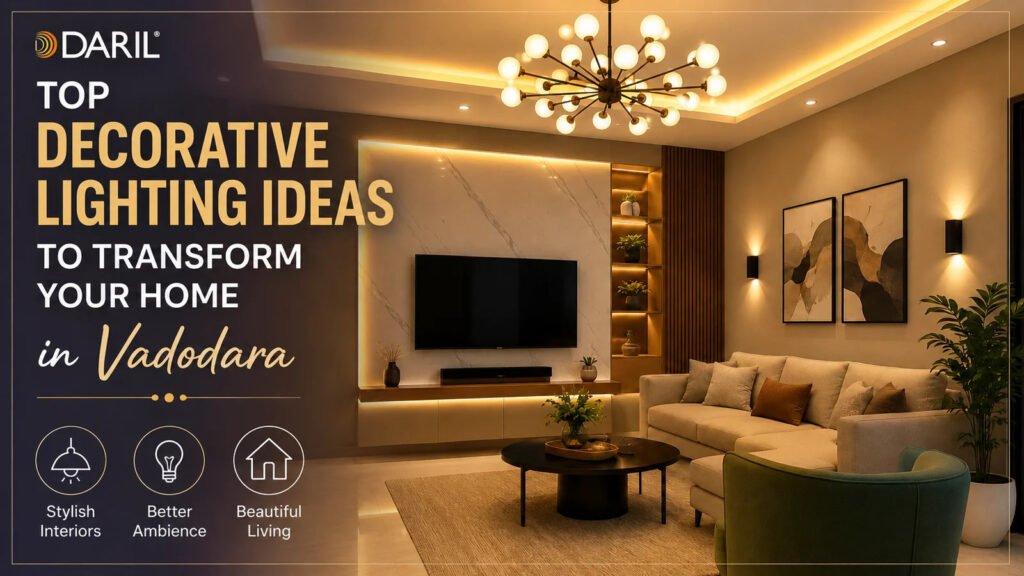
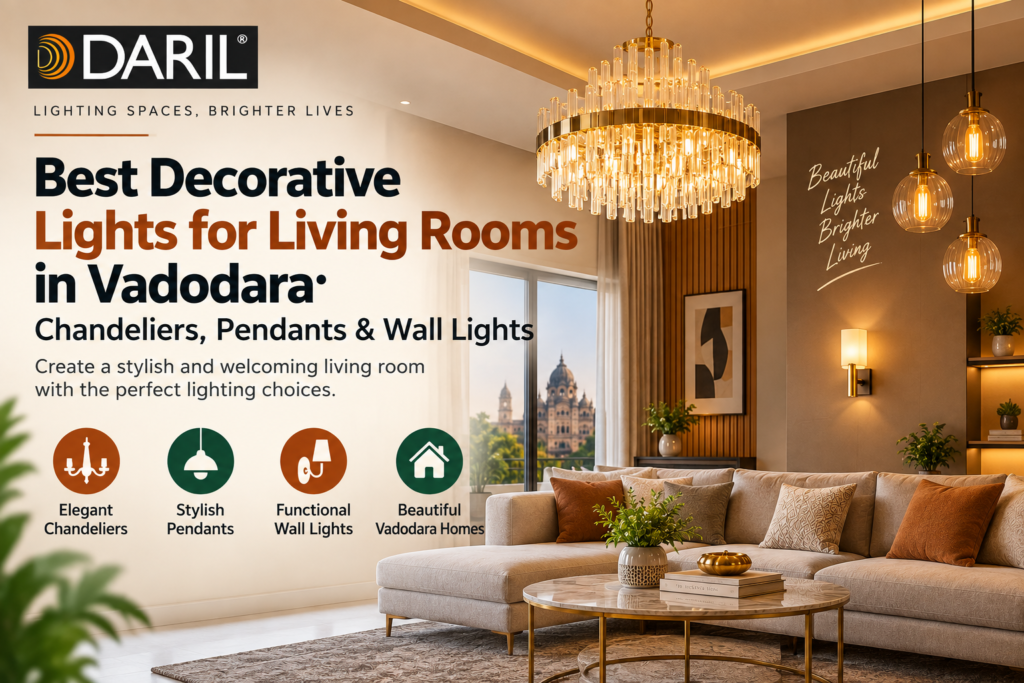
If you are choosing the best decorative lights in Vadodara for a living room, start with three types: a chandelier for a strong center point, pendant lights for focused style, and wall lights for soft layers around the room. The best choice is rarely a single fixture. A well-planned living room usually feels better when several light sources work together.
For most homes, use one main decorative fixture, then add wall or task lights where you need depth. Choose warm white light around 2700K to 3000K for a relaxed mood. Look at lumens for brightness rather than judging a bulb only by wattage.
Your final choice should also fit the ceiling height, room size, furniture layout, wall colors, and daily use. A large chandelier can suit a high-ceilinged room but overwhelm a compact apartment. Pendants work well over a side table or defined seating zone. Wall lights can add depth to TV walls, artwork, textured panels, and passages.
This guide explains how to choose chandeliers, pendants, and wall lights for a Vadodara living room without over-lighting the space or buying only for appearance.
What Are the Best Decorative Lights for a Living Room?
The best decorative lights improve both appearance and everyday comfort. They should suit the room scale, provide useful light, and fit how your family uses the space.
A balanced living room may include:
- One chandelier, pendant group, or decorative ceiling fixture as the visual anchor
- Wall lights for softer background or accent lighting
- Recessed or surface LED lights for general brightness
- A floor or table lamp near a reading or conversation area
- Dimmers or separate switches for different moods
This is layered lighting. Ambient light helps you move around the room. Task light supports reading or other focused activity. Accent light highlights artwork, wall texture, plants, or feature panels.
If you are planning a new interior, decide on the base lighting before buying statement fixtures. This makes it easier to avoid dark corners, excess brightness, and too many competing designs.
How Do Chandeliers, Pendants, and Wall Lights Compare?
Each type solves a different design need.
| Light Type | Best For | Main Advantage | Watch Out For |
| Chandelier | Large or formal living rooms | Strong visual impact | Can overpower low ceilings |
| Pendant light | Modern rooms and defined zones | Flexible placement | A small pendant may look lost |
| Wall light | Accent walls, TV walls, passages | Adds depth without ceiling clutter | Poor spacing can create uneven light |
| Decorative ceiling light | Compact rooms | Clean look with good spread | Less dramatic |
| Floor or table lamp | Reading and flexible mood lighting | Easy to move | Needs floor or surface space |
A chandelier usually works best when the room can support its scale. Pendants are more flexible. Wall lights add visual interest without adding another large ceiling element.
Proportion matters more than fixture type. A beautiful light that is too large, too low, or too bright can make a room less comfortable.
When Should You Choose a Chandelier?
Choose a chandelier when you want the fixture to become part of the room’s main identity. It works well in a larger living room, a double-height space, a formal seating area, or a room with enough clear ceiling height.
How Do You Choose the Right Chandelier Size?
A common sizing method is to add the room length and width in feet, then use that total as a starting diameter in inches.
For example, a 12-foot-by-14-foot living room suggests a starting chandelier size of about 26 inches.
Current India-focused chandelier guides use this formula as a practical starting point.
Treat it as a guide rather than a fixed rule. Furniture scale, ceiling height, and fixture shape still matter.
In an open living-dining plan, size the chandelier for the zone it serves rather than the entire open floor. This helps prevent an oversized fixture.
How High Should a Chandelier Hang?
Where people walk below the chandelier, aim for about 7 feet of clearance between the floor and the lowest part of the fixture. Over a center table, you may have more flexibility because people are less likely to walk directly underneath it.
For low ceilings, consider a compact chandelier or semi-flush fixture. Long-hanging designs can make a standard apartment ceiling feel crowded.
Also check the position of ceiling fans, AC vents, false ceiling sections, and nearby furniture before installation.
Which Chandelier Style Works Best?
Match the fixture to the room:
- Crystal and glass suit formal interiors.
- Brass and warm metal finishes suit classic or contemporary rooms.
- Black metal fits modern or industrial rooms.
- Clear glass keeps a smaller room visually lighter.
- Sculptural fixtures work well when the rest of the room is simple.
View the fixture from both the doorway and the sofa position before making a final decision. A chandelier should feel balanced from different parts of the room.
When Are Pendant Lights Better Than Chandeliers?
Pendant lights are useful when you want a focal point without the visual weight of a full chandelier.
They work well in compact living rooms, reading corners, side seating areas, and open plan homes where one zone needs its own identity.
One pendant can work beside a sofa or over a side table. A pair can balance a wider console. A staggered group can add height and movement in a taller corner.
How Many Pendant Lights Should You Use?
There is no fixed number.
Let the furniture and available ceiling area guide you.
One pendant may be enough for a small reading corner. Two can work over a wider console. A set of three can suit a tall or open space when the fixtures are small enough to work as a group.
Do not add several pendants simply because you have ceiling space. Too many hanging fixtures can make a living room look busy.
Keep enough distance between hanging lights and ceiling fan blades. This matters in Indian homes where a fan and decorative light often share the same room.
Plan the positions before the electrician creates the final ceiling points.
What Makes a Pendant Light Comfortable?
Glare control matters.
A bright exposed bulb near seated eye level can feel harsh during TV time or conversation. Choose a shade, diffuser, frosted globe, or lower-output lamp if the pendant hangs close to the sofa.
Think about maintenance too. Detailed open shades and textured glass may collect dust faster than simple enclosed forms.
A fixture should still be easy to live with after the first few months.
Why Are Wall Lights Important in Living Rooms?
Wall lights make a living room feel layered by adding light closer to eye level.
They can soften the flat look created when all light comes from the ceiling.
Wall lights work well:
- Beside artwork
- Around a TV wall
- Near a hallway opening
- Beside a console
- On textured feature walls
- Beside a reading chair
- Near architectural niches
Uplights can make a ceiling feel taller. Downward-facing lights can highlight wall texture.
Avoid placing a bright light so that it shines directly into the eyes of someone sitting on the sofa.
If you have stone, fluted panels, wallpaper, or artwork, test the direction of light first. A narrow beam can create stronger shadows. A diffused fixture creates a softer effect.
What Color Temperature Is Best for a Living Room?
For most living rooms, warm white light in the 2700K to 3000K range is a good starting point.
Lower Kelvin values look warmer and more yellow. Higher values look cooler and whiter.
Philips Hue describes 2700K as a common warm white choice for relaxing spaces such as living rooms and bedrooms.
Try to keep visible fixtures close in color temperature. Too many different shades of white can make the room feel inconsistent.
| Living Room Use | Suggested Lighting Approach |
| Relaxing and TV time | Warm white, dimmed when possible |
| General family use | Warm to neutral white |
| Reading corner | Brighter task light |
| Artwork or feature wall | Warm accent light with good color rendering |
| Party or festival setting | Dimmable or scene-based lighting |
Color Rendering Index, or CRI, is another useful factor.
The Department of Energy recommends a minimum CRI of 80 for general interior lighting. A CRI of 90 or higher indicates excellent color fidelity.
Good color rendering can help sofa fabric, wood, paintings, stone, rugs, and wall colors look more natural.
This matters when decorative lighting is part of the interior design rather than only a source of brightness.
How Bright Should Decorative Living Room Lights Be?
Do not judge brightness only by wattage.
Lumens measure visible light output. Watts measure the electrical power a lamp uses.
The amount of light you need depends on:
- Room size
- Ceiling height
- Natural daylight
- Wall color
- Curtain color
- Furniture
- Number of fixtures
- How is the room used
Dark walls and heavy curtains absorb more light. Pale walls usually reflect more.
Instead of using a single very bright decorative light source, spread the light across several layers. This often gives better comfort and reduces harsh shadows.
LEDs work well for this approach because of their efficiency and long life.
When comparing LED lights for home interiors, look beyond wattage.
Look at:
- Lumens
- Color temperature
- CRI
- Beam angle
- Dimming support
- Bulb base or fitting
- Replacement options
Two lamps with the same wattage may not produce the same useful light.
How Should You Plan Lighting for Different Living Rooms?
Small Apartment Living Room
Use a compact ceiling fixture or one clean pendant.
Add one or two wall lights if the room needs more depth. Avoid oversized chandeliers unless the ceiling is unusually high.
Slim metal frames, clear glass, and light finishes can help reduce visual clutter.
Medium-Size Family Living Room
A medium chandelier or pendant group can create a clear center point.
Add wall lights near artwork, a console, or a passage. Use separate switches so the room can move from bright family use to softer evening light.
This setup is useful when the same room is used for guests, TV, reading, and family time.
Large or Double-Height Living Room
A large room can support a bigger chandelier, a longer pendant arrangement, or a multi-level lighting feature.
Here, hanging height and structural support become more important.
Confirm that the ceiling and mounting system can support the fixture’s weight. Heavy lights should not be fixed to unsuitable false ceiling material without proper support.
Living Room With a TV Wall
Avoid bright downlights or exposed lamps that reflect on the television screen.
Use softer side lighting, wall washing, or indirect lighting instead.
The goal is to provide enough background light without creating distracting reflections.
Combined Living and Dining Room
Treat the two areas as separate lighting zones.
One decorative fixture can anchor the living room while another defines the dining table.
Keep their finishes, shapes, or materials related so the full space still feels connected.
What Should You Check Before Buying Decorative Lights?
Take your room dimensions, ceiling height, a simple furniture layout, and a few photos of your phone when you visit a lighting store.
Use this checklist before buying:
- Measure room length, width, and clear ceiling height.
- Mark the location of fans and AC vents.
- Check false ceiling positions.
- Identify existing electrical points.
- Decide whether the light is for ambient, task, or accent use.
- Check lumen output.
- Check color temperature.
- Review CRI where available.
- Confirm dimming compatibility if you want a dimmer.
- Check bulb or LED replacement availability.
- Ask how the fixture should be cleaned.
- Confirm fixture weight and mounting method.
- Use a qualified electrician for final installation.
For LED lamps used in India, the Bureau of Indian Standards publishes standards that cover safety and performance.
BIS lists IS 16102 Part 1 for safety requirements and Part 2 for performance requirements for self-ballasted LED lamps used for general lighting.
Certification requirements can vary by product type. Check product markings, electrical compatibility, warranty information, and manufacturer guidance rather than choosing a decorative fixture only for its appearance.
What Common Decorative Lighting Mistakes Should You Avoid?
Avoid these common mistakes:
- Using one ceiling fixture for every lighting need
- Buying a chandelier before measuring the room
- Mixing very warm and very cool white light in the same view
- Using exposed bright sources that create glare from the sofa
- Forgetting the ceiling fan blade sweep
- Ignoring safe hanging clearance
- Choosing intricate fixtures without considering cleaning
- Putting every light on one switch
Separate controls can make a major difference.
You may want full lighting when cleaning or entertaining guests. Later, you can switch off the main fixture and use wall lights or a lamp for TV time and conversation.
This simple control can make the same living room feel very different during the day and evening.
How Do You Match Decorative Lights With Interior Style?
Start with the parts of the room that will stay for years.
Look at your flooring, sofa, wall finish, wood tone, ceiling design, and metal hardware.
Then choose lighting that connects with at least one or two of those elements.
A room with simple furniture can handle a stronger decorative fixture. A room with patterned wallpaper, carved furniture, stone, and several colors may look better with a cleaner light design.
Some easy combinations include:
- Warm metal with beige, cream, brown, or wood interiors
- Black metal with modern neutral interiors
- Clear glass with compact rooms
- Frosted glass with soft contemporary interiors
- Crystal with formal living spaces
- Simple geometric fixtures with minimal interiors
Do not feel that every light must match exactly. They should feel related rather than identical.
You can compare different styles through the decorative lighting collection before deciding what best suits your room.
FAQs About Decorative Lights for Living Rooms
Which Decorative Light Is Best for a Living Room?
It depends on room size and ceiling height. Chandeliers suit larger or taller rooms. Pendants work well for defined zones. Wall lights add softer layers. In many homes, combining two or more types works better than relying on one fixture.
Is Warm White or Cool White Better for a Living Room?
Warm white, usually around 2700K to 3000K, is a common choice for a relaxed living room. Cooler light may help with focused tasks but can feel less cozy during the evening.
Can I Use a Chandelier in a Small Living Room?
Yes. Choose a compact design and maintain safe clearance. A semi flush or shallow chandelier can work better with a lower ceiling than a long hanging design.
How Do I Choose the Right Size Chandelier?
A common starting method is to add the room’s length and width in feet, then use the total as the approximate chandelier diameter in inches. Then adjust the size based on ceiling height, furniture, and fixture shape.
Are Wall Lights Enough for a Living Room?
Usually not by themselves. Wall lights work best as accent or background lighting. Combine them with ceiling or task lighting unless the room has been designed around another complete lighting plan.
Should All Living Room Lights Have the Same Color Temperature?
They do not need to be exactly the same, but keeping them close creates a more consistent appearance. Mixing very warm and very cool white sources in the same room can make the space feel disconnected.
Conclusion
The best decorative lighting plan starts with the room, not the fixture catalog. Measure the space, decide what each light needs to do, and then choose a chandelier, pendant, wall light, or combination that supports comfort and style. Use efficient LED light for everyday living, compare brightness in lumens, pay attention to CRI, and make sure each fixture can be installed safely. If you want to compare decorative options in person and understand what best suits your ceiling height, furniture layout, and interior style, Daril Lighting Solutions can be included on your shortlist when planning a living room lighting update in Vadodara.