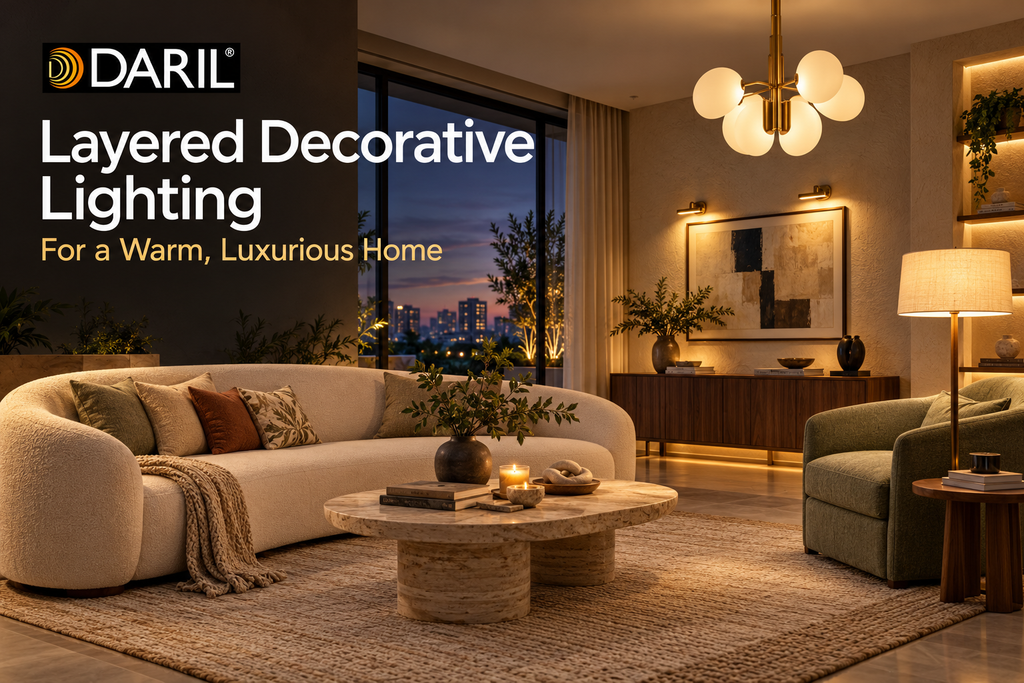
Layer decorative lights by combining soft general light, focused task light, and a few accents on features you want to highlight. Place light at different heights, use warm white where you relax, and give each layer its own control. Aim for comfort and depth rather than turning every fitting on at once.
Start with a ceiling light or indirect glow that makes the room easy to use. Add a lamp where you read. Then highlight one wall, artwork, or display.
If you are comparing home decorative lights in vadodara, take photos of your room and note where you sit, read, and walk. The right choice depends as much on those needs as on the style of the fixture.
You do not need a large chandelier or a false ceiling to create this effect. A modest room can feel warm with a shaded lamp, a simple ceiling fixture, and a well-placed wall light.
Here is how to build the layers without adding glare, clutter, or needless cost.
What Does Layered Lighting Actually Mean?
Layered lighting uses light sources with different jobs. Philips describes three core types: ambient, task, and accent lighting.
Ambient light gives the room a comfortable base level of light. It may come from ceiling fixtures, wall lights, or light bounced off surfaces.
Task light helps with a specific activity. A reading lamp or light over a counter belongs here.
Accent light draws attention to a feature, such as a painting, plant, or textured wall.
Decorative lighting describes the appearance of a fixture, so it can serve any of these roles. A striking floor lamp may light a book. A chandelier may provide part of the room’s general light.
| Layer | Main job | Possible fixtures | Question to ask |
| Ambient | Make the space easy to use | Diffused ceiling light, indirect lighting | Can I move around comfortably? |
| Task | Light an activity | Reading lamp, desk light, focused pendant | Can I see the task without shadows? |
| Accent | Highlight a feature | Picture light, spotlight, shelf light | What deserves attention? |
How Do You Plan the Layers Before Shopping?
Look at the room after sunset. Turn on your existing lights and note what feels wrong.
Can you read on the sofa? Does the center feel bright while the walls look dull? Is a bulb reflected in the TV?
Mark the furniture and walking routes on a simple sketch. Choose one main focal point, such as a dining table, artwork, or textured wall.
Then list what you need:
- Enough general light for movement and cleaning.
- Focused light for reading or other tasks.
- A restrained accent for the chosen feature.
- Separate controls for different activities.
A floor lamp is less useful if its cord must cross a doorway.
How Do You Create a Soft Base Without Making the Room Dim?
Start with comfortable general light. You should be able to see faces, furniture, and changes in floor level.
Diffused fixtures spread light more gently than exposed bulbs. Indirect lighting can soften a room by bouncing light off a ceiling or wall.
A dark ceiling absorbs more light than a pale one, so hidden strips may not create the effect you expect.
Do not depend on cove lighting alone. It can leave the center of a room or a reading seat too dim.
Use general lighting with enough range for daily life. Lower it for a quiet evening, then raise it when you need to clean or find something.
Where Should Task Lights Go?
Put task light close to the activity. This lets you see clearly without making the whole room brighter.
For reading, try a shaded floor lamp beside the chair. Adjust it so the page receives light and the bulb stays out of your direct view.
For a desk, position the lamp so your hand does not cast a shadow over your work. Check the screen for reflections.
At the bedside, give each reader a separate light and control. One person should not need to light the whole bedroom to finish a book.
Task lighting can still look elegant. Choose a fixture whose size, shade, and finish suit the room. Its practical role should guide the final placement.
How Do Accent Lights Add Depth?
Accent lights create a point of interest. They work best when the room gives your eye somewhere clear to rest.
Choose a feature worth showing. A picture light can draw attention to artwork. A concealed shelf light can reveal a collection. A wall light can bring out texture.
Test the beam before fixing the fitting. Move or aim the light until it highlights the feature without shining into someone’s eyes.
Avoid lighting every shelf and wall equally. Too many accents compete with each other and weaken the effect.
For valuable artwork, ask a conservation specialist about suitable exposure. A fixture that looks attractive is not proof that it suits a sensitive object.
Why Do Light Height and Fixture Size Matter?
A room with all its light at ceiling level can feel visually flat. Lamps and wall lights bring light closer to the places people use.
Try combining a higher ceiling source, a lamp near seated height, and one light on a feature. You do not need a fixed number of fittings.
Scale matters too. A wide shade can crowd a narrow side table. A large pendant may block sightlines or feel too low.
Make a paper outline of a proposed fixture before ordering. Hold it in place to judge its width and visual weight.
Check ceiling fans, doors, cabinets, and walking clearance. Ask the installer to confirm safe mounting and the manufacturer’s clearance requirements.
Which Light Color Creates a Warm Interior?
For relaxing areas, 2700K to 3000K is a useful starting range. ENERGY STAR identifies these lower color temperatures as warmer, with a more yellow tone. Higher kelvin values look cooler.
Warm light can suit wood, cream fabrics, and warm metal finishes. Still, test it beside your actual paint, stone, and upholstery.
Warmth and brightness are different. A warm bulb can be bright, while a cool bulb can be dim.
Compare nearby fixtures together. Two products labeled “warm white” may not look identical.
| Area or activity | Light color to test | What to check |
| Living room relaxation | 2700K to 3000K | Skin tones and upholstery |
| Dining | 2700K to 3000K | Food colors and tabletop glare |
| Bedroom evenings | 2700K to 3000K | Comfort from the bed |
| Detailed work | Warm or neutral, as preferred | Clear visibility and reflections |
These are starting points, not rules. Personal preference and visual needs matter.
How Bright Should Each Layer Be?
Compare lumens for light output and watts for power use.
ENERGY STAR’s bulb guide lists about 800 lumens as the brightness equivalent of a traditional 60-watt incandescent bulb. That helps compare bulbs, but it does not tell you how many fixtures a room needs.
Beam angle, shade material, mounting position, and wall colors change the result. A narrow spotlight can make one small area look intense while leaving the rest dark.
Decorative glass and fabric can change how light spreads.
Choose enough output for the job, then use suitable controls where you want flexibility. Do not assume a lower wattage always means a softer appearance.
Explore LED lighting choices with these details in mind.
How Would You Layer a Typical Living Room?
Imagine a Vadodara apartment living room with a sofa, TV, reading chair, and textured wall.
Start with diffused general lighting that serves the main space. Add a reading lamp beside the chair. Use one adjustable accent on the textured wall.
Check the TV from the sofa. If you see a bright reflection, move or redirect the source before fixing it.
Then test three arrangements:
| Activity | Layers to use | What to check |
| Cleaning | General light, with other lights as needed | Clear view of floors and surfaces |
| Reading | Reading lamp plus soft general light | Well-lit page without direct glare |
| Relaxing or hosting | Lower general light and selected accents | Comfortable faces and clear walking routes |
This is a design example, not a fixed plan for every apartment. An older reader may need more light than another person in the same seat.
How Can You Adapt the Idea for Dining and Bedrooms?
What works around a dining table?
Center the pendant over the final table position. Check it from each seat so it does not block conversation or expose a harsh bulb.
Keep some softer light in the surrounding space. A bright table surrounded by darkness can feel uncomfortable.
If the dining area opens into the living room, compare both lighting schemes together.
How should a bedroom feel different?
Use comfortable general light, separate bedside task lights, and an optional gentle accent.
Keep bright sources out of view when lying down. Test indicator lights and illuminated switches at night.
In a compact bedroom, one useful wall light may replace a table lamp. You do not need extra fittings simply to complete a style formula.
Why Are Separate Controls and Dimmers So Useful?
Layers need control. If every light shares one switch, you lose much of the flexibility.
Group lights by purpose. Keep the reading lamp, decorative pendant, and accent lights independently usable.
For dimming, confirm that the LED lamp or driver supports the chosen dimmer. Lutron explains that LED load requirements depend on the particular lamp and control combination.
Ask for a demonstration at low brightness. Check for flicker, buzzing, uneven changes, or lights that fail to turn on reliably.
Smart controls can store settings, but they are optional. Simple switches can create useful lighting arrangements too.
Plan switches and lighting controls before the electrician closes access points. Use a qualified installer for fixed wiring and confirm product compatibility.
Can Layered Lighting Work on a Modest Budget?
Yes. Start by improving one area you use often.
A shaded lamp beside a reading chair may help more than a second decorative ceiling fixture.
Spend first on useful light, comfortable glare control, and suitable switches. Add decorative accents later.
More fittings do not automatically mean high power use, but the total still matters. For example, a group totaling 40 watts uses 0.12 kWh over three hours. That is a sample calculation, not a prediction of your bill.
Compare the full installed price. Include bulbs, drivers, channels, controls, and labor. Ask about replacement parts and warranty coverage.
Buy from authorized sellers where possible, and keep invoices and model details.
What Mistakes Make Decorative Lighting Feel Harsh?
Watch for these common problems:
- Exposed bulbs at seated eye level.
- Different light colors competing in one small area.
- Every accent running at full brightness.
- Long strip lights with visible bright dots.
- Pendants that block views or movement.
- Dark task areas beneath a decorative glow.
Fix placement before adding more power. A shade, a different beam, or a better angle may solve the problem.
For strips, ask about suitable diffusers, power supplies, and accessible drivers. Do not hide service parts where repairs require damage to the ceiling.
Finally, walk through the room at night. Check it from the entrance, sofa, dining chair, and bed, rather than judging only from the center.
Frequently Asked Questions
What are the three layers of home lighting?
The three core layers are ambient, task, and accent lighting. Ambient light serves the room, task light supports an activity, and accent light highlights a feature. A decorative fixture can perform one or more of these jobs.
Can I layer lighting without a false ceiling?
Yes. Use suitable surface lights, wall lights, table lamps, floor lamps, and pendants. Check mounting support and wiring routes. Portable lamps can improve an existing room without changing the ceiling.
Is warm white light always better than cool white?
No. Warm white often suits relaxing areas, but the best choice depends on the task, finishes, and personal needs. Test samples. Brightness, glare, and placement matter as much as light color.
How many decorative lights should a living room have?
There is no fixed count. Start with the activities and features in the room. One general source, a useful task light, and a selected accent may work, but larger or more complex rooms may need a different plan.
Can every LED light work with a dimmer?
No. The lamp or driver must support dimming and match the control. Check the manufacturer’s guidance and test the combination. The word “LED” alone does not guarantee dimmer compatibility.
How can I make lighting look luxurious without overspending?
Use a few well-placed lights, comfortable shades, consistent finishes, and separate controls. Keep glare low and highlight one strong feature. A balanced arrangement often looks more considered than a large number of decorative fittings.
Conclusion: Build Warmth One Layer at a Time
Start with light that makes the room comfortable to use. Add focused light where you work, then a few accents that bring out its character. Test brightness, color, and glare after dark before adding more fixtures.
Bring room photos and your lighting needs to Daril Lighting Solutions. Ask to compare suitable fixtures, see how they spread light, and review the controls with your electrician before choosing the final combination.