Start with general lighting in each room, add light where you work, and then choose decorative fixtures. For most homes, that means ceiling lights, kitchen counter lights, bathroom mirror lights, and bedside lamps before chandeliers or long runs of ceiling strips.
Plan the furniture and switch points before the electrician finishes the wiring. Choose lights by brightness, glare, light color, fit, and ease of repair. Watts alone will not tell you how well a room will feel lit.
If you are searching for the best lighting shop in Vadodara, take your floor plan and room measurements with you. A clear shopping list makes it easier to compare products and avoid buying lights that do not suit your space.
A new apartment may need compact surface lights. A larger home may need separate lighting for stairs, balconies, and several seating areas. Neither needs a decorative fixture in every corner.
Here is what to buy, what to check, and what can wait.
What Should You Decide Before Buying Any Lights?
Start with how you will use each room. Mark the sofa, dining table, beds, kitchen counters, wardrobes, and desks on your plan.
Then note three layers:
- General light: Helps you move around and see the room.
- Task light: Lights a specific activity, such as chopping food or reading.
- Accent light: Highlights a wall, artwork, shelf, or feature.
You do not need all three in every space. A small passage may work well with simple ceiling lights. A living room used for reading and hosting may need more choice.
Record ceiling heights, false ceiling depth, and window positions. Check the room after sunset too.
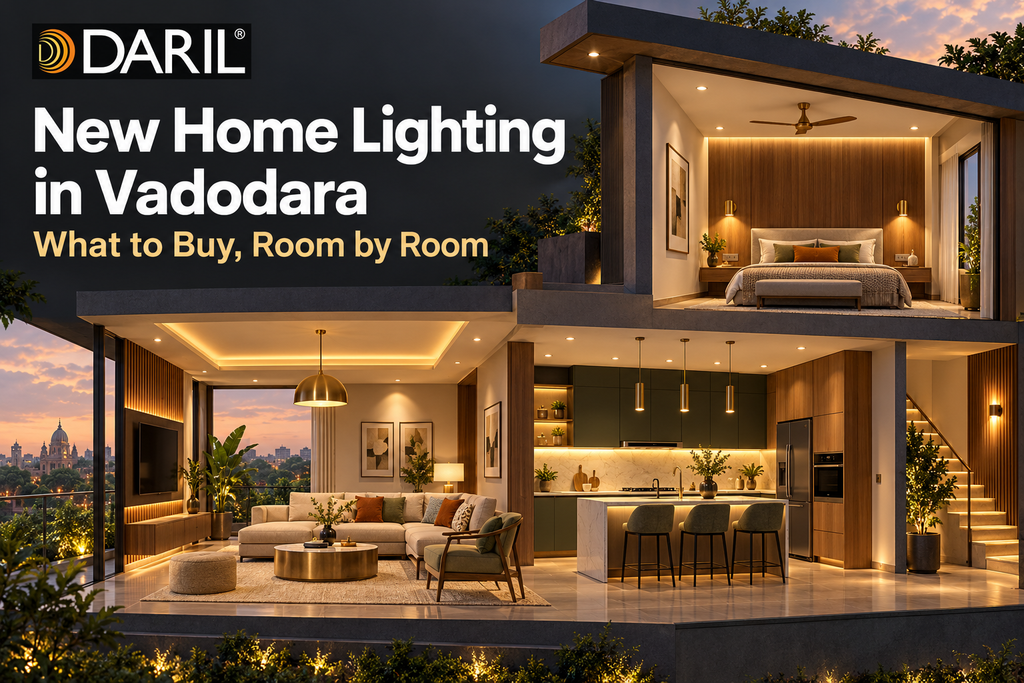
What Belongs on Your Room-by-Room Shopping List?
Use this table as a starting point. Final quantities depend on the room, fixture output, beam spread, and layout.
| Space | Buy first | Add if useful | Key placement check |
| Entrance | Ceiling or wall light | Console lamp | Light the lock and threshold |
| Living room | Diffused ceiling lighting | Reading lamp, wall lights | Keep glare off the TV |
| Dining area | Light over the table | Dimmer | Align with the final table position |
| Bedroom | General light, bedside light | Wardrobe lighting | Avoid glare while lying down |
| Kitchen | General and counter lighting | Cabinet lighting | Light the worktop without body shadows |
| Bathroom | Suitable ceiling and mirror lights | Night light | Check moisture exposure and fixture suitability |
| Study | General light and desk lamp | Shelving light | Keep reflections off screens |
| Pooja space | Soft general or focused light | Shelf lighting | Keep fittings clear of heat and flames |
| Balcony | Outdoor-rated fixture | Adjustable accent light | Check rain exposure |
| Stairs | Even light along the route | Step lights | Make tread edges visible |
What Lights Should You Buy for the Living Room?
What should provide the main light?
Choose diffused ceiling fixtures or a planned arrangement of downlights. A diffuser softens the visible light source.
Light should suit the seating, doors, and room shape.
For example, a room used for family visits, reading, and watching TV benefits from separate controls. You can use the main lights for cleaning and a lamp for a quiet evening.
When should you add decorative lights?
Add a pendant, wall light, or floor lamp when it serves a clear purpose. One well-placed feature can be enough.
Check the fixture from a seated position. An exposed bulb may look attractive in a showroom but feel harsh above your sofa.
Place TV-area lights so they do not reflect on the screen. Keep fan blades clear of nearby fittings and coordinate both layouts before installation.
Browse decorative lighting options after you confirm the room’s basic light needs.
What Should You Buy for the Dining Area?
Choose a pendant or chandelier that suits the table, ceiling height, and room scale.
Center the light over the table, rather than automatically centering it in the room. Finalize the table position before fixing the ceiling point.
A wide table may benefit from a linear fixture. A compact table may suit one smaller pendant. Check how the fitting looks from every seat.
Ask the installer to set a height that keeps sightlines clear and places the light comfortably above the surface.
If you want dimming, buy a compatible fixture, driver, and dimmer together. Ask for a demonstration at low brightness. Do not assume every LED will dim smoothly.
What Lights Work Best in Bedrooms?
What should you buy first?
Start with comfortable general lighting and a separate light for each person who reads in bed.
Bedside wall lights save table space. Table lamps offer more freedom if you may move the furniture later.
Check switches from the bed.
Place ceiling lights so you do not stare into bright sources while lying down. Use a shaded or diffused design where needed.
Should you light the wardrobe?
Add wardrobe lighting if the room light leaves shelves and hanging clothes in shadow. A door sensor can be useful, but check its operation and access for repairs.
For a child’s room, provide a clear light for homework and softer light for winding down. Keep loose cords and unstable lamps away from play areas.
A dim night light can help with movement without lighting the whole room.
What Should You Buy for the Kitchen and Utility Area?
The kitchen needs light on the work surface as well as across the room.
Buy a general ceiling fixture, then check the sink, stove, and food preparation counter. If you stand between the ceiling light and the counter, your body may cast a shadow.
Under-cabinet lights can solve that problem. Choose a suitable linear fitting or strip system with a diffuser. Philips includes under-cabinet lighting among its kitchen lighting options.
For strip lighting, confirm:
- Strip voltage and power per meter.
- Driver capacity and compatibility.
- Suitable channels and diffusers.
- Access to drivers after installation.
- Protection appropriate to heat, grease, and moisture exposure.
Use a separate switch for counter lights. You may not need every ceiling light on while making tea.
In the utility area, prioritize clear light over the washing machine, sink, and storage. Buy fixtures that are easy to clean and suitable for the conditions.
Compare LED lighting options using output, fit, and service access.
What Lighting Does a Bathroom Need?
Buy suitable general lighting and separate mirror lighting. A ceiling light alone can leave shadows on your face.
Try a broad mirror light or balanced lighting around the mirror. Check the effect while standing where you shave, apply makeup, or wash.
Philips recommends layered bathroom lighting, including lighting for grooming and general use.
Ask a qualified electrician to confirm fixture placement, moisture protection, and the electrical protection needed for the installation. Do not assume every bathroom location needs the same IP rating.
An IP rating describes protection against solids and water. It does not replace correct wiring or make a fitting suitable for every wet location.
Keep switches and electrical connections appropriately placed. Follow the product instructions and applicable local requirements.
What Should You Buy for a Study or Home Office?
Use general room light with an adjustable desk lamp. A bright screen in a dark room is not a complete lighting plan.
Place the lamp so your hand does not block the page. Right-handed users can try light from the left; left-handed users can try the reverse.
Check the monitor for reflections before fixing wall or ceiling lights. Move the lamp or adjust its angle if needed.
Choose controls that let you change brightness for paper work, video calls, and screen use.
Do not buy on claims such as “eye-friendly” alone. Ask about glare control, dimming performance, and the manufacturer’s stated flicker characteristics.
What Works for Pooja Spaces, Passages, and Balconies?
How should you light a pooja space?
Choose soft light that makes the space easy to see. A small focused light may highlight the main feature without lighting the entire wall.
Keep fittings, wires, and drivers clear of diyas, incense, and other heat sources.
What do entrances, stairs, and passages need?
Light changes in level, doorways, and stair edges. Do not rely only on a decorative fitting that creates deep shadows.
Plan switching from useful access points. For stairs, arrange controls so users can turn the light on before entering the route.
What should you buy for a balcony?
Choose a fixture rated for its actual outdoor exposure. A sheltered balcony and an open terrace face different conditions.
Check rain, dust, cleaning access, and glare toward nearby homes. Keep decorative strips optional until the main lighting works well.
How Do You Compare Brightness and Light Color?
Why should you compare lumens instead of watts?
Lumens describe light output. Watts describe power use. Two lights with the same wattage can give different amounts of light.
ENERGY STAR’s bulb guide uses about 800 lumens as the brightness equivalent of a traditional 60-watt incandescent bulb. This is a bulb comparison, not a room sizing rule.
Ask for help with fixture spacing and beam spread. A narrow spotlight and a broad ceiling panel can have similar output but light a room very differently.
Which light color should you choose?
Color temperature, shown in kelvin, describes the light’s warm or cool appearance. Lower numbers look warmer; higher numbers look cooler.
| Starting preference | Light color to test | Common uses |
| Warm and relaxed | 2700K to 3000K | Living rooms, bedrooms, dining |
| Clear and neutral | Around 4000K | Counters, mirrors, desks |
| Cooler appearance | 5000K to 6500K | Utility areas, if preferred |
These are design starting points, not rules. Compare samples against your tiles, paint, and wood finishes.
For nearby fixtures in the same visual area, check that the light colors look consistent.
Does color rendering matter?
Yes. Color rendering affects how natural objects look under a light. Ask about the color rendering index, or CRI.
Consider higher-CRI options where judging skin tones, food, or clothing colors matters. Compare real samples rather than relying only on a box label.
How Can You Control Costs Without Losing Comfort?
Buy working light before decorative light. Prioritize counters, mirrors, desks, and safe movement routes.
ENERGY STAR’s bulb guide notes that certified LEDs can provide the same brightness with up to 90% less energy than traditional incandescent bulbs. That comparison does not mean replacing one modern LED with another will cut consumption by the same amount.
Avoid adding more fittings simply because each one uses little power. Total power and running time still matter.
For example, ten 8-watt lights use 80 watts together. Running them for five hours uses 0.4 kWh. Separate controls let you use only the group you need.
Compare the full installed cost, including drivers, channels, connectors, dimmers, and labor. Ask about replacement parts and written warranty terms.
Plan switches and lighting controls while wiring remains accessible.
What Should You Check Before Placing the Final Order?
Bring a room-wise list showing fixture type, finish, light color, quantity, and control method.
Before paying, confirm:
- Recessed cutout size and mounting depth.
- Clearance around fans, cabinets, and doors.
- Driver access and replacement options.
- Dimmer or smart control compatibility.
- Fixture suitability for the installation location.
- Invoice, warranty coverage, and service process.
Buy through authorized sellers where possible.
Test a sample fitting before ordering a large batch. Check it at night with the room’s finishes in place.
Frequently Asked Questions
How many lights do I need in each room?
There is no reliable fixed count for every room. Room size, ceiling height, surface colors, fixture output, and beam spread all matter. Ask for a layout based on your floor plan and activities, then check the result on site.
Is warm white or cool white better for a home?
Both can work. Many people prefer warm light for relaxing areas and neutral light for tasks. Test the shade against your finishes. Light color does not tell you brightness, so compare lumens separately.
Can I use ceiling lights without a false ceiling?
Yes. Surface-mounted lights, suitable pendants, wall lights, and lamps offer options without a false ceiling. Check mounting support and wiring routes before buying. Recessed fittings need enough space and a suitable mounting surface.
Are LED strip lights enough for a living room?
Not always. Hidden strips often provide a soft glow but may leave reading and seating areas too dim. Treat them as one layer. Check the full room after dark before deciding whether you need general or task lights.
When should I buy lights for a new home?
Plan early, before wiring and ceiling work are complete. Confirm technical details before cutting openings or closing access points. Choose final decorative finishes once furniture positions and room dimensions are clear.
Should all home lights use the same color temperature?
They do not have to. Different rooms can suit different light colors. In an open living and dining space, a consistent appearance often feels calmer. Test transitions before committing to large quantities.
Conclusion: Buy for Daily Life First
A good lighting plan helps you cook, read, relax, and move comfortably. Start with furniture positions, choose useful light in each room, and add decorative pieces where they bring value. Check glare, controls, and service access before installation.
Bring your floor plan, finish samples, and room-wise list to Daril Lighting Solutions. Ask to compare suitable fixtures and confirm the details with your electrician before placing the final order.