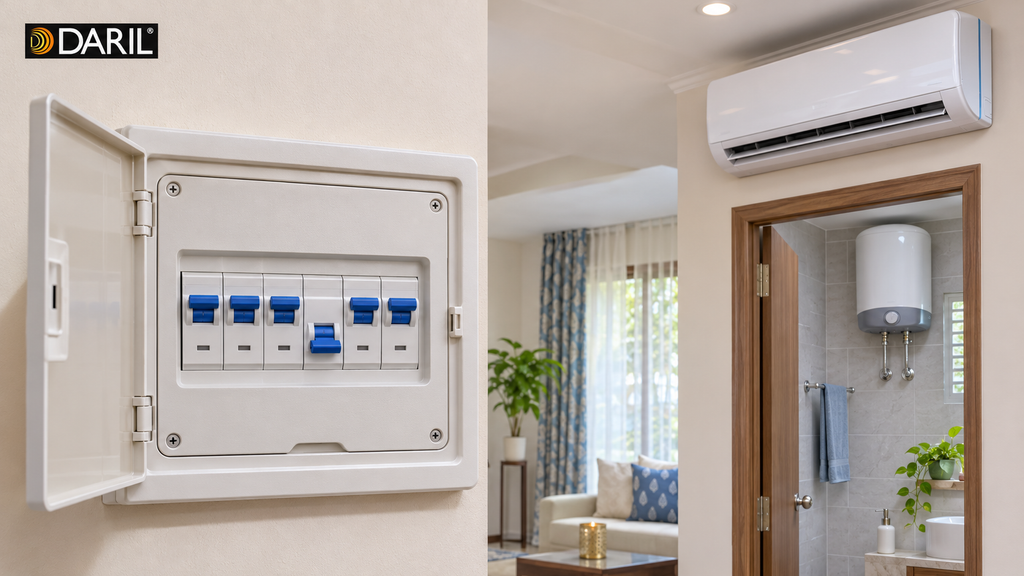
An MCB may trip when an AC or geyser starts because the circuit is overloaded, the AC draws a brief surge, or a fault causes excess current. The breaker, wiring, or connections may also need repair. If an RCCB or RCBO trips instead, earth leakage could be involved.
A trip is a sign to check the cause. It does not prove that the breaker is weak or that you need a higher amp rating.
For an AC, the fault may relate to startup load or a failing part. For an electric geyser, think about the heating element, wiring, total load, and possible leakage.
Before visiting an MCB dealer in Vadodara, have a qualified electrician identify which device tripped and why. Buying a replacement first can leave the real fault in place.
Do not keep resetting a breaker that trips again. Leave the affected circuit off and arrange a check. Stop using any point that smells burned, sparks, or shows damage. Electrical Safety First lists burning smells, crackling, and repeated trips among warning signs that need attention.
Is It the MCB, RCCB, or RCBO That Trips?
Many homeowners call every switch in the board an MCB. These devices serve different roles.
| Device | Main role | What a trip may suggest |
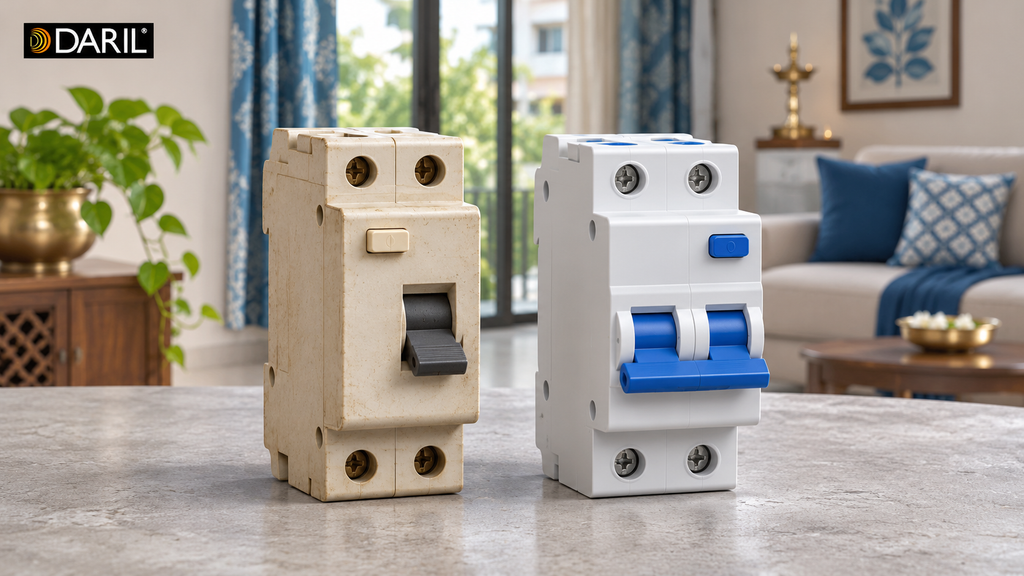
| MCB | Protects against overloads and short circuits | Excess current or a circuit fault |
| RCCB | Detects residual current, often called earth leakage | Current leaving its intended path |
| RCBO | Combines both types of protection | Overcurrent or residual current |
An RCCB does not provide overload protection on its own. An RCBO includes that function.
A test button may help identify a residual current device. Still, read the visible model details or ask an electrician to confirm.
Do not remove the board cover to inspect parts. A photo of the closed board and its labels can help the contractor prepare.
What Does the Timing of the Trip Tell You?
Timing gives useful clues. It cannot confirm the cause on its own.
| When it trips | Possible causes to investigate |
| As the AC starts | Startup current, compressor fault, wiring fault, or unsuitable protection |
| As the geyser turns on | Wiring fault, element fault, leakage, or existing circuit load |
| After several minutes | Sustained overload, heat at a connection, or a fault that appears when warm |
| When both appliances run | Shared circuit overload or total supply load |
| During rain or damp weather | Moisture entering wiring, controls, or equipment |
Tell the electrician what you noticed during normal use.
Why Can an AC Trip the Breaker at Startup?
Does the Compressor Draw Extra Current?
Some AC compressors draw a brief high current as they start. This is often called inrush or starting current.
The circuit and breaker must suit the equipment’s normal starting behaviour.
However, AC designs differ. Many inverter models control startup differently from fixed-speed units. Do not assume every AC draws the same surge.
A trip can mean that normal startup and circuit protection do not match. It can also mean the appliance has a fault.
The electrician needs measured results and the AC manual to tell the difference. Schneider Electric’s troubleshooting guidance recommends checking whether inrush exceeds the breaker’s instantaneous trip level.
Could an AC Part Have Failed?
A compressor that struggles to start can draw too much current. On models that use one, a failed start or run capacitor may contribute.
Faults in a fan motor, wiring, or inverter power board can also cause problems.
These checks belong to a trained AC technician. Do not open the outdoor unit, handle capacitors, or try to bridge parts.
Ask the service team to work with the electrician if the fault could lie in either the AC or its supply circuit.
Can Poor Airflow Play a Part?
Blocked airflow, dirty coils, or a failing fan can make an AC work under strain. That may contribute to faults during use.
Daikin’s guidance notes that clogged filters can reduce airflow and increase power use. Cleaning may help performance, but it does not prove that a tripping circuit is safe.
Why Can a Geyser Trip the Breaker?
Does a Geyser Have the Same Startup Surge as an AC?
A normal resistance heating element does not have the same motor starting surge as a conventional AC compressor.
If a geyser causes an immediate trip, do not dismiss it as normal startup behaviour.
The circuit may already be overloaded. A short circuit, damaged cable, or appliance fault may also be present.
If you are reviewing electric geyser options, check the required power and circuit needs before buying.
Could the Heating Element Leak Current?
An element with failed insulation can allow current to leak toward earth. An RCCB or RCBO may then trip.
This can happen at startup or after the element warms up.
A technician must test the element and wiring. The pattern alone cannot prove which part failed.
Do not remove the earth wire to stop a trip. That removes a key safety measure and leaves the fault unresolved.
Could Water Reach Electrical Parts?
Leaks, damp wiring, or damaged seals can put moisture near live parts.
Stop using a geyser if water is leaking near its controls or wiring. Keep away from wet switches and arrange service.
A repair may need both plumbing and electrical work. Replacing only the breaker will not fix water ingress.
Can the AC and Geyser Overload a Shared Circuit?
Yes. Even sound appliances can overload a circuit when their combined demand is too high.
For a simple resistance load, current is roughly power divided by voltage.
At an assumed 230 V:
| Example load | Approximate current |
| 2,000 W geyser | 8.7 A |
| 3,000 W geyser | 13.0 A |
| 2,000 W kettle | 8.7 A |
| 3,000 W geyser plus 2,000 W kettle | 21.7 A |
These are examples, not a wiring design.
A 21.7 A load exceeds a 16 A rating. That does not mean the breaker must trip at once. Trip time depends on the overload, heat, and the device’s time-current curve.
For an AC, use its nameplate and maker’s circuit guidance. Cooling capacity in tons is not its electrical input power.
Also, separate wall switches do not prove that appliances have separate circuits. The electrician must trace the layout.
What Do B and C Mean on an MCB?
An MCB has an amp rating and a trip curve. They describe different things.
The amp rating relates to the current the device is designed to carry under stated conditions. The curve helps describe how it reacts to excess current.
CPWD guidance gives these magnetic trip ranges:
| Curve | Magnetic trip range |
| B | About 3 to 5 times rated current |
| C | About 5 to 10 times rated current |
These ranges relate to fast magnetic operation. They do not mean a breaker can carry those currents all day.
A C-curve device may suit some motor loads. It is not a universal fix for an AC trip.
Changing the curve can affect fault clearance. The electrician must check the appliance instructions, wiring, fault conditions, and protective design before selecting one.
Why Should You Avoid Installing a Bigger MCB?
The breaker protects the circuit wiring. A larger rating may allow more current than the cable or connections can safely carry.
Changing a 16 A breaker to a 25 A model without checking the circuit can remove needed protection.
Cable size alone does not settle the matter. Installation method, cable grouping, heat, length, and terminal ratings also matter.
If the circuit cannot serve the load, the right repair may involve a new circuit or other changes.
A breaker that stays on is not proof of a safe repair.
Ask for the reason behind any proposed rating change. “This one will stop tripping” is not enough.
Can Loose Connections or Heat Cause Trouble?
A loose or poor connection can create local heat. At the breaker terminal, that heat may affect thermal tripping or damage the device.
Poor connections elsewhere can also overheat without drawing enough extra current to trip the MCB.
This is why a circuit can be unsafe even when the breaker stays on.
Signs worth reporting include:
- A burned smell.
- Brown marks around a switch.
- Buzzing or crackling.
- Melted plastic.
- Flickering linked to appliance use.
Do not touch a point to check whether it feels hot.
Schneider Electric’s guidance also notes that high surrounding temperatures affect thermal trip behaviour. A hot, crowded board needs assessment, rather than a larger breaker.
Can Low Voltage Cause an MCB to Trip?
Low voltage can affect an AC’s ability to start or run. The result depends on the motor, controls, and equipment design.
A thermal-magnetic MCB does not trip simply because voltage is low. It responds to overcurrent. An AC may also stop through its own voltage protection while the MCB remains on. Daikin describes protective shutdowns during large voltage changes.
A fixed-resistance geyser behaves differently. Lower voltage generally reduces its current and heating output.
Tell the technician if lights dim or the AC reports a voltage error. Do not assume that a stabiliser will solve every trip.
What Can You Safely Check Before Calling?
Focus on what you can observe without opening equipment.
- Note which visible device has tripped.
- Record which appliance was starting.
- Note other large loads running at the time.
- Write down whether the trip was immediate or delayed.
- Mention rain, leaks, smells, noises, or recent repairs.
- Find the appliance model and previous service details.
Do not keep restarting the appliance to test a theory. Do not open sockets, tighten board terminals, or use a meter inside the panel.
If you see smoke or active arcing, keep people away and seek emergency help. Do not approach damaged equipment to operate it.
What Should the Electrician and Service Technician Test?
A useful inspection goes beyond swapping the breaker.
Depending on the fault, the team may check:
- Running current and startup current.
- Voltage at the appliance.
- Cable condition and circuit layout.
- Insulation resistance.
- Earth continuity and leakage.
- Breaker rating, curve, and condition.
- Connections and signs of heat damage.
- Appliance parts linked to the fault.
Some tests need the appliance isolated. Others require controlled live measurements by trained people.
Ask for a plain explanation of the findings. It should identify the likely cause, repair, and checks made before reuse.
If the issue involves switches and electrical controls, include those parts in the repair scope.
How Can You Reduce Repeat Trips After Repair?
Follow the maker’s circuit and service instructions.
Avoid multi-plug adapters and extension boards for high-power fixed appliances. Do not add a large load to a circuit without checking its capacity.
Keep water leaks away from wiring. Arrange AC cleaning and service at the intervals the brand recommends.
Have damaged switches and wiring repaired promptly.
Keep the circuit labels clear and save the repair record.
Frequently Asked Questions
Is It Normal for an MCB to Trip When an AC Starts?
No recurring trip should be accepted as normal. Startup current can be a factor, but the circuit should suit the AC’s stated needs. A fault, an incorrect protective device, or a wiring problem may need repair.
Why Does My Geyser Trip After a Few Minutes?
Possible causes include overload, a heating element fault that appears when warm, or heat at a poor connection. If residual current protection trips, leakage may be involved. Testing is needed to identify the cause.
Can I Replace a 16 A MCB With a 25 A MCB?
Only after a qualified electrician confirms that the full circuit and appliance requirements allow it. A larger breaker can leave wiring underprotected. Do not choose a higher rating just to prevent trips.
Does an MCB Protect Against Electric Shock?
An MCB mainly protects against overloads and short circuits. It is not a substitute for residual current protection. Earthing and appropriate RCCB or RCBO protection have separate roles in electrical safety.
Can a Faulty MCB Cause Repeated Tripping?
Yes, but other causes must be checked first. A technician should inspect the load, wiring, heat damage, and appliance. Replacing the breaker without tests may hide the real problem or waste money.
Should I Call an Electrician or an AC Technician?
Start with an electrician when the tripped device or circuit is unclear. An AC technician should check internal AC faults. For a geyser, use the brand’s service team where appropriate.
What Is the Safest Next Step?
Identify the tripped device and leave recurring faults off until checked. Do not bypass protection, remove earthing, or fit a bigger breaker without a full circuit assessment.
Once an electrician has written the required specification, contact the showroom to compare suitable products. Daril Lighting Solutions can help with product details while your qualified contractor handles fault diagnosis, installation, and testing.