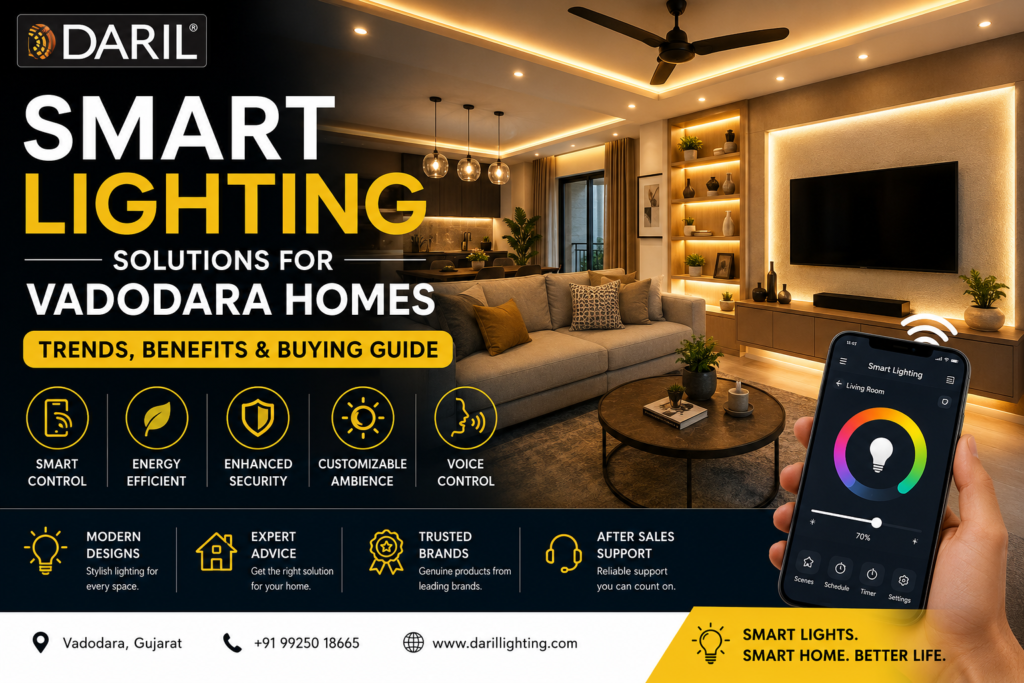
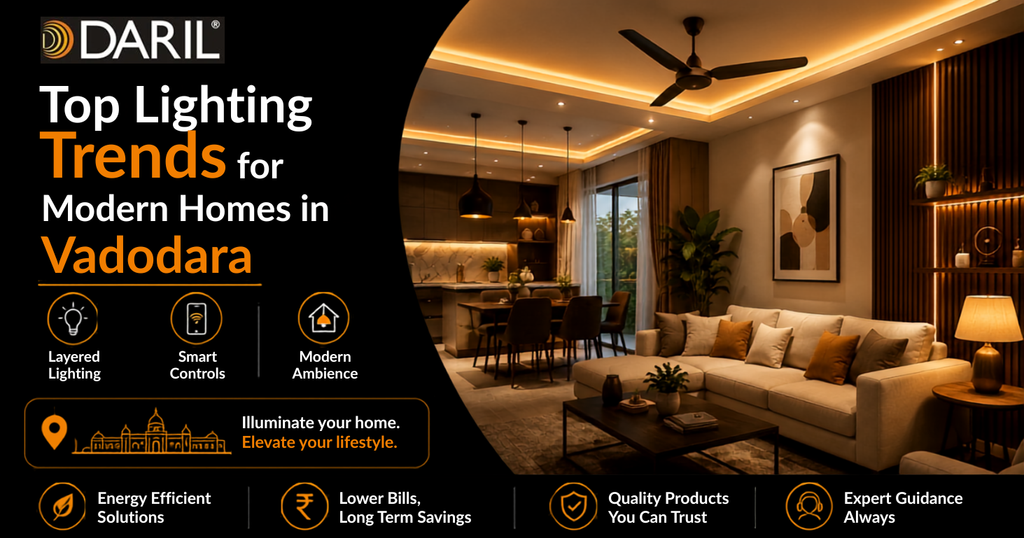
Lighting trends for modern homes in Vadodara are moving toward a simple idea: use light to make each room comfortable, useful and visually balanced instead of relying on one bright ceiling fixture. In 2026, the strongest trends include layered lighting, warm white LEDs, concealed architectural lighting, statement pendants, smart controls, task lighting and better attention to colour quality. Recent Indian design coverage also points to a shift from harsh, single-source lighting toward softer, layered and more flexible schemes.
If you are searching for the best lighting shop in Vadodara, look beyond fixture style. Ask how the light will be used, what colour temperature suits the room, whether dimming is needed, how much glare the fitting creates and whether the product suits the intended installation. Good lighting should support daily activities first, then add mood and design value.
For most modern homes, the best result comes from combining three layers: ambient light for general visibility, task light for activities such as cooking or reading, and accent light for artwork, textures or architectural details. Layering is increasingly being recommended in Indian residential design because it makes one room more adaptable to different activities and moods.
Top Lighting Trends at a Glance
| Lighting trend | Best use | Why it works |
| Layered lighting | Living rooms, bedrooms, kitchens | Adds depth and flexibility |
| Warm white LEDs | Living and sleeping spaces | Creates a softer feel |
| Cove lighting | False ceilings, TV units, passages | Gives clean architectural light |
| Statement pendants | Dining, foyer, kitchen island | Creates a focal point |
| Smart lighting | Bedrooms, living rooms, entrances | Enables scenes, schedules and dimming |
| Task lighting | Kitchens, studies, wardrobes | Improves visibility |
| Accent lighting | Art, niches, textures, shelves | Highlights selected details |
1. Why Is Layered Lighting a Major Trend?
Layered lighting means using more than one type of light in the same room. Instead of filling the ceiling with identical downlights, you plan separate sources for different jobs.
A modern living room might use recessed or cove lighting for general brightness, a floor lamp near a reading chair, wall lights for atmosphere and a focused spotlight for artwork. Each layer can work independently, so the room can feel bright during cleaning and calmer during an evening with family.
Architectural Digest India reported in May 2026 that Indian homes are increasingly moving away from harsh, singular white lights toward layered ambient lighting, sculptural lamps and diffused glows.
For more room-specific inspiration, see decorative lighting ideas for Vadodara homes. This URL is included in the uploaded Daril internal-link list.
2. Are Warm White Lights Better for Modern Homes?
Warm white lighting is useful for living rooms, bedrooms and dining spaces because it creates a softer atmosphere. A common warm white range is around 2700K to 3000K, while neutral white around 4000K can suit kitchens, study zones and work areas where clearer task visibility is preferred. Current Indian lighting guidance uses similar room-based recommendations.
A simple room guide is:
- Living room: Warm white for relaxed evenings
- Bedroom: Warm white, with dimming where practical
- Dining area: Warm white for a comfortable ambience
- Kitchen worktop: Neutral white for task visibility
- Study or home office: Neutral white for focused work
Avoid mixing very warm and very cool lamps randomly within the same visual zone. Keeping related fixtures reasonably consistent can make wall colours, furniture and finishes look more balanced.
3. Why Are Cove and Concealed Lights Popular?
Cove lighting, under-shelf LEDs, and concealed linear lighting suit modern interiors because the light source can become part of the architecture rather than visually dominating it. Instead of seeing a bright bulb directly, you see reflected light on the ceiling, wall or furniture.
This approach works well around false ceilings, TV units, wardrobes, headboards, display shelves and passages. Concealed lighting is most useful as a supporting layer, rather than the only source of illumination. Modern Indian lighting guides similarly recommend combining architectural lighting with task and accent sources.
If you are renovating, this LED lighting guide for new home interiors in Vadodara can help you plan lighting before ceiling and electrical work is finalised.
4. Are Statement Pendants and Decorative Lights Still in Style?
Yes. Decorative lighting is becoming more sculptural, but the practical trend is to use fewer statement pieces with more purpose.
A pendant over a dining table, a chandelier in a double-height space or a pair of bedside pendants can become part of the interior even when switched off. Current 2026 Indian design coverage highlights sculptural fixtures, architectural illumination and decorative lighting that contributes to the room’s overall character.
Scale matters. A large chandelier can overwhelm a compact apartment, while a tiny pendant may disappear in a wide dining area. Consider ceiling height, table size, viewing angles and maintenance access before purchasing.
You can explore decorative lighting options when comparing fixture styles for different rooms.
5. How Is Smart Lighting Changing Home Design?
Smart lighting is becoming less about novelty and more about useful control. Depending on the system, homeowners can use dimming, schedules, scenes, motion sensing, app control or voice control. Current smart-lighting guidance also highlights adjustable brightness and colour temperature as useful tools for rooms that serve more than one purpose.
Useful examples include:
- A bright morning scene
- A softer evening scene
- Automatic passage lighting
- Scheduled outdoor lights
- Dimming for movie or dining time
- Convenient bedside controls
Smart lighting does not automatically reduce electricity use. Any savings depend on how the system is set up and how people use it. Its strongest practical benefit is flexibility.
Before buying, check whether the system needs Wi-Fi, Bluetooth, a hub, specific switches or a compatible app. Also ask whether manual switching still works if the internet is unavailable and whether compatible replacement products are likely to remain available.
6. Why Does LED Quality Matter More Than Wattage?
Wattage alone does not tell you how good a lamp will look or perform.
The Bureau of Indian Standards has updated IS 16102 (Part 1): 2026 to include safety requirements for self-ballasted LED lamps. BIS laboratory information for LED lamp performance testing also includes luminous flux, luminous efficacy, colour rendering, lumen maintenance, beam characteristics and endurance-related testing.
When comparing LEDs, check:
- Lumen output
- Colour temperature
- Colour Rendering Index, or CRI
- Beam angle
- Dimming compatibility
- Driver quality
- Product warranty
- Applicable BIS marking or compliance information
India’s UJALA programme also shows the national scale of efficient lighting adoption. A Ministry of Power statement reported that more than 36.9 crore LED bulbs had been distributed under UJALA and estimated annual electricity savings of about 48.4 billion units, with annual consumer electricity bill savings of approximately Rs 19,337 crore. These figures are national programme estimates, not a guarantee of savings for an individual home.
See LED lights for relevant lighting categories.
7. Why Is Task Lighting Getting More Attention?
Task lighting puts light where work actually happens. This is especially useful in modern homes where one room may serve several purposes.
In a kitchen, task lighting can illuminate the countertop below wall cabinets. In a bedroom, a focused bedside lamp can support reading without lighting the whole room. In a home office, a desk lamp can improve visibility without making the entire room overly bright.
Placement matters. A badly positioned spotlight can cast shadows on a work surface or create uncomfortable glare. Plan the source around the user’s position, furniture and activity. Layered residential lighting guidance consistently treats task lighting as separate from general ambient light.
8. How Can Accent Lighting Improve an Interior?
Accent lighting draws attention to selected details instead of lighting everything equally. It works well for textured walls, artwork, indoor plants, niches, shelves and display cabinets.
For example, a stone feature wall may look flat under general ceiling lighting. A controlled wall wash or spotlight can reveal more of its texture. A shelf can gain depth from a concealed strip. The goal is not maximum brightness. The goal is useful contrast and visual hierarchy.
This focus on lighting walls, textures, and architectural features is also evident in current interior-lighting guidance, which increasingly treats light as part of the room design rather than merely a source of visibility.
Which Lighting Trend Works Best in Each Room?
| Room | Recommended approach |
| Living room | Layered warm lighting, accent lights, dimming |
| Bedroom | Warm ambient light, bedside task lights |
| Kitchen | General light plus focused countertop lighting |
| Dining area | Pendant or chandelier with warm supporting light |
| Home office | Neutral task lighting with glare control |
| Bathroom | Clear general and mirror lighting with suitable fixtures |
| Passage | Simple ceiling or wall lighting, sensors if useful |
| Balcony | Weather-suitable fixtures with controlled glare |
For bathrooms, balconies, and exterior areas, confirm that fixtures are suitable for the location and expected exposure. Electrical installation should be handled by a qualified professional and should comply with applicable product, wiring, and safety requirements.
How Should You Choose Lighting for a New Home in Vadodara?
Start with the room, not the fixture catalogue. List what happens in each space. A living room may need space for conversation, television viewing, reading, and entertaining. A kitchen needs task visibility. A bedroom benefits from calmer general lighting and convenient bedside control.
Then decide:
- Where general light is needed
- Which activities need task light
- Which surfaces deserve accent light
- Whether dimming or smart control is useful
- Which colour temperature suits the room
- Where switches should be placed
- Which fittings need easy maintenance access
A showroom visit is most useful when you compare actual light output, glare, finish and scale rather than choosing only from photographs.
What Lighting Mistakes Should Homeowners Avoid?
One common mistake is relying on one bright source for the whole room. Recent Indian design coverage increasingly recommends layered lighting so that general illumination, task needs and ambience can be controlled separately.
Also avoid choosing only by wattage, mixing colour temperatures without a plan, overusing downlights, creating glare, hiding LED drivers where they cannot be serviced and buying decorative fittings before checking ceiling height.
Most importantly, do not treat electrical safety as a design detail. Check applicable product standards and manufacturer information, and use a qualified or licensed electrical professional where required.
Frequently Asked Questions
The FAQ set below targets common People Also Ask search themes related to living rooms, bedrooms, kitchens, colour temperature, and smart home lighting. Current search results commonly surface questions such as what lighting is best for a living room, how to choose bedroom lighting and which lighting works best in kitchens.
1. What type of lighting is best for a living room?
A layered plan works well for most living rooms. Combine general ambient light with a reading or task light and one or two accent sources. Warm white light is commonly used when the goal is a softer, more relaxed living space.
2. Is warm white or cool white better for a home?
Neither is best everywhere. Warm white around 2700K to 3000K suits many living and sleeping areas, while neutral white around 4000K can work well in kitchens, studies and other task zones.
3. How do I choose lighting for a bedroom?
Use soft general lighting, bedside task lights and easy-to-reach controls. Dimming can be useful if the lamps and controls are compatible. Avoid strong glare near the bed.
4. What lighting is best for a modern kitchen?
Use general ceiling lighting plus focused task lighting over counters, sinks and preparation areas. Decorative pendants can be added over an island or dining counter if they do not block sightlines.
5. Are smart lights worth it for a home?
They can be worthwhile if you value dimming, schedules, scenes or remote control. Check compatibility, internet dependence, manual control and replacement availability before choosing a system. Smart-lighting systems can offer advanced control, but the exact features vary by platform.
6. How can I make home lighting look more premium?
Use fewer but better-planned sources. Layer ambient, task and accent lighting, reduce glare, keep colour temperature reasonably consistent within a visual zone and use decorative fixtures where they create a clear focal point.
Conclusion
The top lighting trends for modern homes in Vadodara are not about filling every ceiling with new fixtures. The stronger approach is thoughtful layering, warm, comfortable lighting where appropriate, efficient LEDs, focused task lighting, controlled accent lighting, and smart features that solve a real need. Plan lighting before finalising false ceilings, furniture and electrical points, compare products in person and verify relevant safety and performance information. If you are exploring lighting for a new home or renovation, Daril Lighting Solutions is a local place to compare lighting categories and understand how different fixtures may work together in your space.