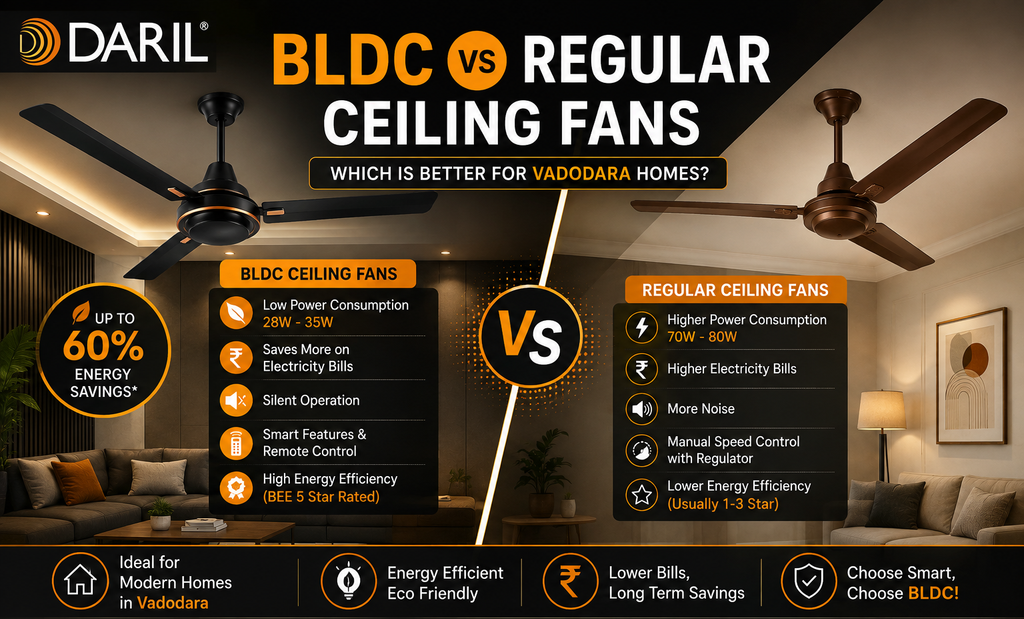
For most Vadodara homes where ceiling fans run for several hours every day, a BLDC ceiling fan is usually the better long-term choice because it provides useful airflow while consuming much less electricity than a typical induction-motor fan. Current manufacturer specifications and buying guidance commonly list many BLDC ceiling fans at around 28 to 35 watts, compared with roughly 70 to 80 watts for many conventional models, although actual consumption varies by model, speed, and design.
That does not mean every homeowner should immediately replace every working regular fan. A conventional fan may still make sense in a rarely used guest room, a rental property, or a space where low upfront cost matters more than long operating hours. The right decision depends on daily usage, power input, air delivery, room size, product quality, warranty and purchase price.
If you are comparing models through a ceiling fan distributor in Vadodara, do not judge a fan only by the words “BLDC”, “high speed” or “energy saving.” Check the actual BEE label. For electric ceiling fans, the Bureau of Energy Efficiency label includes power input, air delivery, service value and star level. BEE defines the star rating based on energy efficiency and service value.
What Is a BLDC Ceiling Fan?
BLDC stands for Brushless Direct Current. In a BLDC ceiling fan, electronic control manages the motor rather than relying on the conventional induction-motor arrangement found in many standard ceiling fans.
The practical result is lower electrical power demand for a given level of useful air movement in many current products. For example, current manufacturer comparisons show many BLDC models operating around 28 to 35 watts at their rated conditions, while typical conventional ceiling fans may consume around 70 to 80 watts. Always compare specific products rather than treating these numbers as universal ratings.
BLDC fans may also include features such as remote controls, timers, sleep modes and multiple electronic speed settings. Features vary by model, so buyers should check the manufacturer’s specifications before purchasing.
What Is a Regular Ceiling Fan?
A regular ceiling fan generally refers to the conventional ceiling fan design commonly found in Indian homes, often using a single-phase induction motor.
These fans remain widely used because the technology is familiar, many models have straightforward controls, and there is a wide choice of designs and price points.
However, the term “regular fan” does not necessarily imply inefficiency. Ceiling fans sold under India’s efficiency framework can have different star ratings, and BEE bases the label on measurable performance information rather than simply whether the motor is labelled BLDC.
That distinction is important. BLDC is a motor technology. BEE star rating is an energy-efficiency rating.
BLDC vs Regular Ceiling Fan: Quick Comparison
| Factor | BLDC Ceiling Fan | Regular Ceiling Fan |
| Typical power use | Often lower | Often higher |
| Motor control | Electronic BLDC system | Usually conventional induction design |
| Upfront price | Usually higher | Often lower |
| Electricity use over time | Lower for comparable usage | Generally higher |
| Speed control | Often remote or electronic | Commonly wall regulator |
| Smart features | Available on many models | Less common on basic models |
| Best use | Long daily operating hours | Low-use or budget-focused rooms |
| Buying priority | Efficiency plus air delivery | Price plus air delivery |
| Maintenance | Electronics should be considered | Familiar conventional design |
The actual difference depends on the exact products being compared. Check the rated power and air delivery rather than relying solely on category names.
How Much Electricity Can a BLDC Fan Save?
Electricity savings depend mainly on four things:
- Power consumption of each fan
- Number of operating hours
- Number of fans in the home
- Your actual electricity tariff
Consider an illustrative comparison between a 75-watt conventional fan and a 35-watt BLDC fan. These are example values within the ranges seen in current manufacturer comparisons, not guaranteed figures for every fan.
If each fan runs for 10 hours per day:
| Example | 75W Regular Fan | 35W BLDC Fan |
| Daily running time | 10 hours | 10 hours |
| Annual electricity use | 273.75 kWh | 127.75 kWh |
| Illustrative cost at ₹8/kWh | ₹2,190 | ₹1,022 |
| Illustrative annual difference | ₹1,168 |
Under these assumptions, the energy difference is 146 kWh per fan per year. For three fans operating under the same assumptions, the illustrative saving would be about ₹3,504 per year at ₹8 per kWh.
The ₹8 figure is only an example for easy comparison. Your real savings will depend on your electricity tariff, the fan’s actual wattage, and operating hours.
Why Does the BEE Star Label Matter?
India’s Bureau of Energy Efficiency includes ceiling fans in its Standards and Labelling programme. BEE’s appliance information identifies ceiling fans as appliances covered under mandatory labelling, with the ceiling-fan programme dating back to May 2022.
For consumers, the most useful information is not simply the number of stars. Look at:
- Power input in watts
- Air delivery
- Service value
- Star level
- Manufacturer and model details
- Label period
BEE’s regulations state that the star rating is based on service value, which relates useful air delivery to power input.
That means a lower-watt fan should not be judged in isolation. You also want enough air movement for the room.
BEE reported that its overall Standards and Labelling programme covered 38 appliance categories in 2025 and estimated savings of 89.80 billion units across the programme. That figure covers the full programme and should not be interpreted as ceiling-fan-only savings.
Does a BLDC Fan Give Less Air Because It Uses Less Power?
Not necessarily.
Power consumption and air delivery are separate specifications. A properly designed, efficient fan can use less electricity while still delivering useful airflow.
This is why you should compare air delivery and wattage together. Current manufacturer guidance also recommends comparing the CMM air-delivery figure on the label rather than assuming that a lower-watt BLDC fan must be weaker.
For example, imagine two 1200 mm fans:
- Fan A consumes less power but delivers less air.
- Fan B consumes slightly more power but delivers much stronger airflow.
Fan B may be more suitable for a particular room even if its wattage is higher.
The goal is not to buy the fan with the lowest watt number. The goal is to find a good balance between air delivery, efficiency, room coverage, comfort and cost.
You can compare available ceiling fan options before deciding which motor type and design best suits each room.
Which Fan Is Better for Vadodara’s Long Fan-Use Season?
For rooms where fans operate for many hours, energy efficiency becomes more valuable because small hourly differences accumulate over months and years.
This makes BLDC fans particularly worth considering for:
- Bedrooms used every night
- Living rooms with long daily occupancy
- Children’s rooms
- Home offices
- Frequently used kitchens or dining areas where ceiling fans are suitable
- Homes where several fans operate at the same time
A regular fan may remain reasonable for a guest bedroom or occasional-use space where it runs only a few hours each month.
Instead of asking, “Which technology is always better?”, ask, “How many hours will this specific fan operate?”
That question gives you a more realistic basis for deciding whether paying more upfront for an efficient model makes sense.
Can BLDC Fans Work With an Inverter or Home Backup?
Many modern BLDC ceiling fans are designed to operate at relatively low power, which can make them attractive in homes using inverter or battery backup.
Lower fan wattage means a group of fans can require less electrical power while running. However, backup runtime depends on the entire system, including battery capacity, inverter efficiency, battery condition and every appliance connected at the same time.
Do not assume that buying a BLDC fan guarantees a specific number of backup hours.
Check the fan manufacturer’s voltage and power requirements and confirm inverter compatibility where necessary.
Can You Use a Normal Wall Regulator With a BLDC Fan?
Do not assume that you can.
Many BLDC fans use their own electronic speed-control system and are supplied with remote controls or dedicated control methods. Compatibility with a conventional wall regulator depends on the specific fan.
Before installation, read the manufacturer’s instructions.
If the product states that a normal electronic or resistance-type regulator should not be used, follow that requirement. Incorrect controls can cause poor operation or other problems.
During a renovation, it is useful to plan the fan and switch arrangement together. You can review electrical switches and controls when deciding how you want wall controls, lighting and fans organised in each room.
Are BLDC Fans More Expensive?
BLDC fans often cost more upfront than basic conventional ceiling fans because their motors and electronic controllers are more sophisticated. Current manufacturer comparisons also identify the purchase-price premium as one of the main trade-offs when choosing BLDC technology.
Whether that extra cost is worthwhile depends on usage.
Suppose a BLDC model costs ₹1,500 more than the conventional fan you are considering. If your usage pattern produces an illustrative annual electricity saving of around ₹1,168, the simple payback could be a little over a year.
But that is only an example.
A fan used for two hours per day will recover the additional purchase cost much more slowly than one used for ten or twelve hours.
Do not rely on generic claims such as “pays for itself in one year.” Calculate using your own shortlisted models.
What Should You Check Before Buying a Ceiling Fan?
1. Check the Wattage
Lower power consumption can reduce operating costs, but wattage should be compared alongside airflow.
2. Compare Air Delivery
Air delivery indicates how effectively the fan moves air. Compare the values on shortlisted models.
3. Check the BEE Label
Confirm power input, air delivery, service value and star rating. BEE requires these particulars on the ceiling-fan energy label.
4. Check the Sweep Size
The suitable sweep depends on room dimensions, layout and installation position. Do not select a fan only because a larger number appears more powerful.
5. Consider Controls
Decide whether you prefer a wall regulator, remote, timer or smart-control features.
6. Check Warranty and Service
BLDC fans contain electronic controls, so warranty coverage for the motor and electronics is worth comparing.
7. Verify Product Compliance
The Bureau of Indian Standards lists IS 374:2019 for electric ceiling-type fans. BIS currently lists electric ceiling-type fans under its compulsory certification Scheme I, linked to the Electric Ceiling Type Fans Quality Control Order, including an amendment dated February 13, 2026.
BIS laboratory information for IS 374:2019 includes testing areas such as air performance, fan speed, power input, starting, silent operation and endurance.
Check applicable markings and product documentation, and use a competent electrician for safe installation.
When Is a Regular Ceiling Fan Still a Good Choice?
A regular fan can remain practical when:
- The room is rarely used
- Initial budget is limited
- You prefer basic controls
- The existing fan is working well
- Replacement energy savings would be small because usage is low
There is little reason to discard a properly functioning fan solely because BLDC technology exists.
A sensible home upgrade can be phased. Replace high-use fans first, then consider other rooms when existing fans reach the end of their useful life.
This approach reduces upfront spending while directing efficiency improvements toward the rooms where they can have the greatest effect.
When Should You Choose a BLDC Fan?
BLDC becomes especially attractive when:
- The fan operates for many hours every day
- Electricity consumption is an important consideration
- Multiple fans run simultaneously
- You value remote or electronic controls
- You are furnishing a new home
- You are replacing an old high-consumption fan
- Lower power demand during inverter use matters to you
For a new home, compare total lifetime use rather than just the showroom price.
A fan is often used for years. Even a moderate difference in daily electricity consumption can become significant over a long ownership period.
Frequently Asked Questions
1. Is a BLDC fan really better than a normal fan?
For long-term daily use, a good BLDC fan often offers a strong advantage due to its lower power consumption. A normal fan may still be practical where usage is low and upfront cost matters most. Compare BEE label data for the actual models.
2. How much electricity does a BLDC fan use?
Many current residential BLDC models are in the 28 to 35-watt range, while conventional models are often around 70 to 80 watts. Exact consumption varies, so check the rated power on the product and BEE label.
3. Does a BLDC fan run slower than a normal ceiling fan?
Not simply because it uses less electricity. Fan performance should be judged by air delivery, rated speed, and room suitability rather than by wattage alone.
4. Can a BLDC fan work without a remote?
It depends on the model. Control systems vary between manufacturers. Some use remotes or electronic wall controls, so always check the specific installation instructions.
5. Are BLDC fans good for inverter use?
Their lower power demand can be helpful during battery backup, but actual backup time depends on the complete inverter system and connected load.
6. Is a 5-star fan always a BLDC fan?
Do not assume so. BEE star ratings represent energy-efficiency performance based on service value, while BLDC describes the motor technology. Check both the technology and the BEE label.
Conclusion
For the most frequently used rooms in Vadodara, a well-selected BLDC ceiling fan can be a sensible long-term upgrade, as lower power consumption reduces energy use without requiring homeowners to give up useful airflow. Regular ceiling fans still have a place in low-use rooms and budget-focused projects. Compare wattage, air delivery, BEE star rating, service value, warranty, controls and overall purchase cost before deciding. If you want to compare ceiling fans for different rooms rather than choosing based on specifications alone, you can contact the local team to review suitable options with Daril Lighting Solutions.